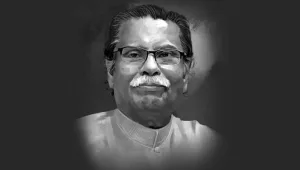
The Nobel Prize in Literature is one of the most prestigious and globally recognized awards, presented each year to one or more writers for outstanding contributions to literature. Continuing that tradition, the 2025 Nobel Prize in Literature has been awarded to Hungarian writer László Krasznahorkai. The Swedish Academy announced his name on 9 October.
In its citation, the Swedish Academy stated:
“He has been awarded the prize for his compelling and visionary body of work, which revives the power of art even amid the terrors of apocalypse. He is an epic writer of Central European literature. His writings are often compared to those of Franz Kafka and Thomas Bernhard.”
Krasznahorkai received the award particularly for his novel “Herscht 07769,” set against a German backdrop.
László Krasznahorkai was born in 1954 in Gyula, a small town in southeastern Hungary near the Romanian border. A similarly remote rural setting forms the backdrop of his debut novel “Satantango,” published in 1985. The novel gained immense popularity in Hungarian literary circles and is widely regarded as the author’s breakthrough work.
Written in a powerful, symbolic language, Satantango portrays the lives of a destitute community living on an abandoned collective farm in rural Hungary just before the fall of communism. The narrative is dominated by silence and anticipation. Two key characters—Irimiás and his friend Petrina—are believed by everyone to be dead, but suddenly reappear one day.
Their return leads the waiting villagers to view them either as bearers of hope or harbingers of judgment. The novel explores themes of deception, as Irimiás is revealed to be a manipulative figure full of pretense and trickery. Gradually, the entire community becomes trapped by his deceit.
As a result, every character in the novel waits for a miraculous event. A shared hope takes hold of them all:
“I will wait for it—otherwise I might miss it.”
This celebrated novel was later adapted into a film in 1994 by renowned director Béla Tarr.
American critic Susan Sontag famously described Krasznahorkai as the “master of the apocalypse” in contemporary literature after reading his second novel “Az ellenállás melankóliája” (1989), translated into English as “The Melancholy of Resistance” (1998). In this novel, dramatic intensity builds within a terrifying allegorical tale set in a small Hungarian town in the Carpathian Basin.
In contrast, his novel “Háború és háború” (1999)—translated into English as “War and War” (2006)—shifts the author’s focus beyond Hungary’s borders. Another major work is his 2003 novel “A Mountain to the North, a Lake to the South, Paths to the West, a River to the East.” This novel poetically portrays the mystical world of Kyoto, Japan, where a goddess named Seiobo guards a garden that bears the fruit of immortality once every three thousand years.
Based on this novel, Krasznahorkai later wrote the literary collection “Seiobo There Below.” The book contains 17 carefully structured stories that explore beauty and art in a rapidly changing world—one whose beauty is increasingly difficult to grasp. The stories open with a striking image of a heron waiting by the Kamo River, symbolizing a meditation on the process of artistic creation. They suggest that art emerges through long preparation and refined skill, yet can also be shaped by unexpected events.
Krasznahorkai lived in Berlin, Germany, for several years and served as a visiting professor at the Free University of Berlin for six months. He currently lives in seclusion on a mountain in Hungary. He divorced his first wife, Anikó Pelikán, in 1990, and married Dóra Kopcsányi in 1997, a sinologist and graphic designer. He has three children—Kata, Ágnes, and Panni.
Previously, Krasznahorkai won the Man Booker International Prize in 2015 and the National Book Award for Translated Literature in 2019.