In Sylhet-4 (Gowainghat, Companiganj and Jaintiapur) constituency, the latest election rally of BNP candidate Ariful Haque Chowdhury was held on Sunday in Companiganj upazila. The rally took place at around 3:30 p.m. at the playground of the Companiganj Thana Sadar Government Model High School, drawing a large crowd.
Before the main speakers arrived, a speaker was seen addressing the gathering from the stage at around 2:45 p.m. At that time, Ariful Haque Chowdhury and other senior leaders had not yet reached the venue. The speaker said, “Shaheed President Ziaur Rahman declared independence in favor of Bangabandhu Sheikh Mujibur Rahman.” Upon inquiry, the speaker was identified as Borhan Uddin Khandaker, a lawyer by profession and joint secretary of Companiganj Upazila BNP.
When asked whether he mentioned Sheikh Mujibur Rahman’s name to attract Awami League voters in favor of the BNP’s electoral symbol, Borhan Uddin denied the claim. He said, “No, not at all. I stated historical facts. There is no benefit in denying Bangabandhu, just as there is no benefit in exaggerating Ziaur Rahman.”
Sources indicate that candidates are employing both open and discreet strategies to attract voters traditionally aligned with the Awami League, whose activities remain banned. Some candidates have even requested Awami League supporters to cast their votes freely and without fear. Several candidates, speaking on condition of anonymity, acknowledged that similar efforts are underway across all six parliamentary constituencies in Sylhet.
A senior leader of the Sylhet district Awami League, currently in hiding and speaking anonymously, said that both BNP and Jamaat have fixed voter bases. However, he noted that Awami League–aligned voters and religious minorities play a decisive role in determining electoral outcomes. “If these voters turn out and support a candidate, that candidate will naturally gain a significant advantage,” he said, adding that this explains the intense efforts by BNP and Jamaat to secure these votes.
Multiple local sources reported that several BNP candidates are making behind-the-scenes attempts to win over Awami League–leaning voters. Some candidates have allegedly held phone conversations with Awami League leaders in hiding, seeking their assistance in influencing local voters. Similar efforts are also being made by candidates from the Jamaat-led 11-party electoral alliance. In some cases, former upazila chairmen, union chairmen, and influential Awami League leaders are reportedly seeking votes quietly in favor of BNP and Jamaat candidates.
Meanwhile, Ariful Haque Chowdhury, BNP candidate for Sylhet-4 and former mayor of Sylhet City Corporation, recently addressed the issue of Awami League supporters during a street rally in his constituency. He stated, “We have no conflict with those who were involved with the Awami League if they were not engaged in terrorism. If they go to vote and anyone tries to stop them, we will take action against that person.”
Leaders from multiple political parties noted that all six parliamentary constituencies in Sylhet have significant numbers of Hindu voters. Additionally, constituencies such as Sylhet-1 also include voters from Christian and Buddhist communities, along with large populations from the tea garden communities and the Manipuri ethnic group. Candidates from BNP, Jamaat, and other parties are actively courting these voters.
Local residents said that in areas populated by religious and ethnic minorities, candidates have organized rallies, courtyard meetings, street gatherings, and door-to-door campaigns. Candidates have promised various initiatives, including the construction and renovation of temples and cremation grounds, in an effort to gain support. Competition between BNP and Jamaat candidates to secure these votes has been particularly intense.
The reporter also spoke with four prominent leaders from the Hindu and Manipuri communities in Sylhet city, all of whom requested anonymity. They said BNP and Jamaat candidates had held multiple meetings with community representatives before and after the election schedule was announced, seeking their support and blessings. Candidates also attended various social and religious events for the same purpose.
There is no official data on the exact number of Hindu or tea community voters in Sylhet district. However, Rajat Kanti Bhattacharjee, vice president of the Bangladesh Puja Udjapan Parishad, Sylhet district, estimates that there are approximately 350,000 Hindu voters in the district, with 75,000 to 80,000 of them in the Sylhet-1 constituency.
According to Raju Goyala, executive committee president of the Bangladesh Tea Workers’ Union, the district has 12 tea gardens in Sylhet Sadar, 7 in Jaintiapur, 3 in Fenchuganj, 2 in Gowainghat, and 2 in Kanaighat, with an estimated 40,000 to 50,000 voters in these tea estates. All political parties are actively trying to secure these votes.
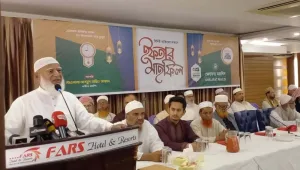
On Monday at around 12 noon, the Sylhet district and metropolitan Jamaat-e-Islami held a press conference in the Dhopadighirpar area of Sylhet city. Metropolitan Jamaat Ameer Muhammad Fakhrul Islam claimed that following the August 5 mass uprising, Jamaat was the first to take initiatives to protect communal harmony. He said party members guarded homes, businesses, temples, and religious sites of minority communities, adding that Sylhet witnessed the highest number of religious celebrations after the uprising due to ensured security.
Without naming the BNP, Fakhrul Islam accused rival parties of spreading false narratives to attract minority votes. “They claim that we are threatening minorities from going to polling stations and that people of other religions will not be able to practice their faith if we come to power. These allegations are not only false and fabricated but also laughable,” he said.
Earlier, on Sunday, Sylhet BNP held a press conference in the Kazirbazar Ucha Road area, alleging that voters from religious and ethnic minority communities in different parts of Sylhet were being intimidated and threatened to prevent them from going to polling stations. On Friday night, a BNP delegation led by district BNP president Abdul Qayyum Chowdhury also met the Returning Officer to raise the same concerns.