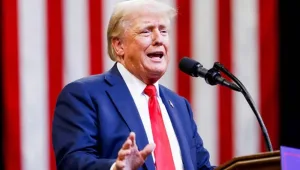
U.S. President Donald Trump has announced an increase in tariffs on nearly all imported goods, raising the rate from 10 percent to 15 percent.
The announcement was made Saturday via a post on his social media platform, Truth Social, just hours after the U.S. Supreme Court struck down a previous round of global retaliatory tariffs imposed by his administration.
Supreme Court Blocks Earlier Tariff Plan
On Friday, the Supreme Court ruled against the Trump administration’s earlier move to impose broad retaliatory tariffs under emergency economic powers. In a 6–3 decision, the Court said the president had overstepped his authority by applying high tariff rates under legislation designed for economic emergencies.
The ruling stated that the administration had misused the law by invoking emergency powers to justify sweeping trade measures affecting global imports.
Despite the legal setback, Trump moved quickly to introduce new tariffs under a different trade statute.
New Tariffs Under “Section 122”
The newly announced 15 percent tariff is being implemented under Section 122 of U.S. trade law. This provision allows the president to impose tariffs of up to 15 percent without congressional approval, but only for a limited period of 150 days. Any extension beyond that timeframe would require congressional authorization.
In his Truth Social post, Trump said he intends to use the 150-day window to implement additional tariffs that are “legally authorized.”
The administration is reportedly considering two additional trade laws that allow tariffs based on national security concerns or investigations into unfair trade practices. These statutes could enable targeted tariffs on specific countries or industries.
Trump Defends Tariff Increase
In his statement, Trump argued that the United States has been economically disadvantaged by global trade partners for decades.
“As President of the United States, I am immediately raising the 10 percent tariff currently imposed on countries around the world to a 15 percent level,” he wrote. “Many countries have taken advantage of the United States for decades without consequence (until I arrived!). From now on, it will be a legally tested and maximum 15 percent rate.”
The president maintains that he retains broad authority to adjust tariff levels despite the Supreme Court’s ruling.
Escalating Trade Tensions
The latest move signals that Trump is not retreating from his aggressive trade stance, even after the judicial setback. Instead, the administration appears to be shifting its legal strategy to maintain tariff pressure on global imports.
The decision is expected to have wide-ranging implications for:
-
International trade relations
-
Consumer prices in the United States
-
Supply chains
-
U.S. relations with major trading partners
Economists warn that broad tariff increases could drive up costs for businesses and consumers, potentially impacting inflation and global market stability.
Political and Legal Fallout
The Supreme Court’s ruling was supported by six justices, with three dissenting. Following the decision, Trump publicly criticized members of the judiciary, insisting that his authority over trade policy remains intact.
The dispute underscores an ongoing power struggle between the executive branch and the courts over the limits of presidential authority in economic and trade matters.
With the new tariff policy set to take effect immediately, the coming weeks are likely to see renewed debate in Congress and reaction from global trading partners.