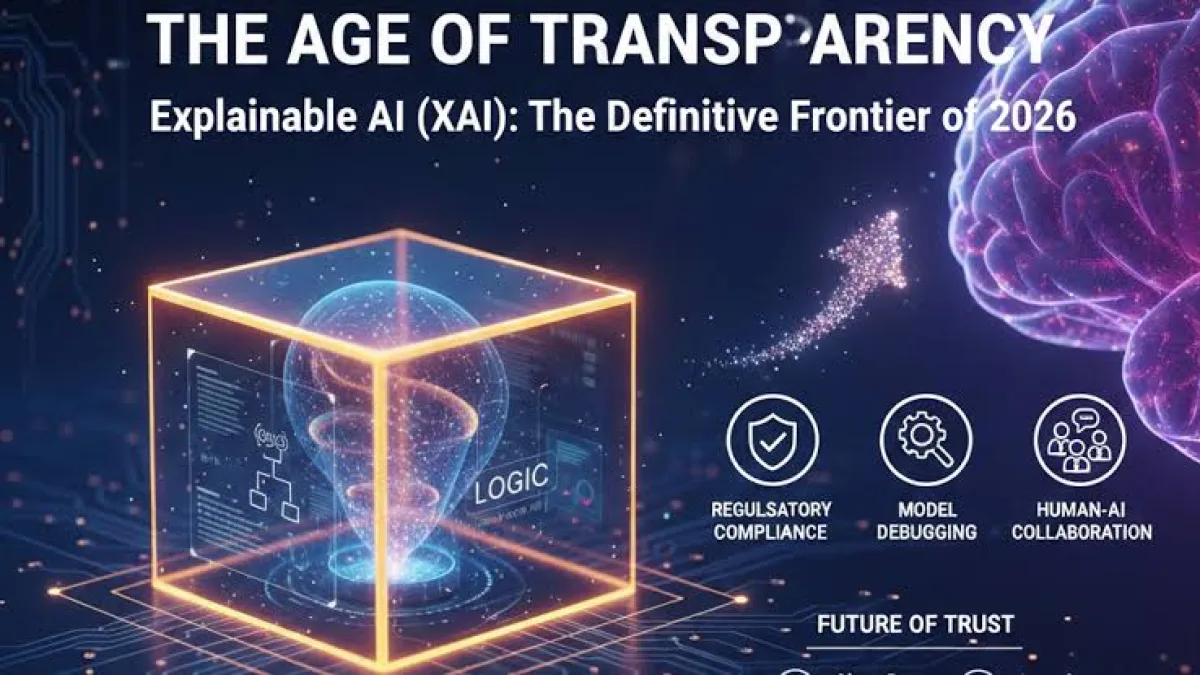
Artificial Intelligence is becoming deeply integrated into nearly every aspect of modern life. From approving bank loans and diagnosing diseases to detecting fraud and managing supply chains, AI systems are making decisions that directly affect millions of people. While these technologies deliver impressive speed and accuracy, many advanced AI models operate like "black boxes," producing results without explaining how they reached their conclusions. In 2026, this lack of transparency has become a major concern for governments, businesses, regulators, and consumers. As a result, Explainable AI (XAI) has emerged as one of the fastest-growing areas in artificial intelligence.
Explainable AI refers to the development of AI systems that not only produce accurate predictions but also provide understandable explanations for their decisions. Instead of simply generating an output, XAI helps users understand why a recommendation was made, which data influenced the outcome, and how confident the AI is in its conclusion. This transparency builds trust and allows organizations to use AI more responsibly.
One of the primary reasons Explainable AI is gaining importance is regulatory compliance. Governments worldwide are introducing stricter AI regulations that require organizations to demonstrate fairness, accountability, and transparency in automated decision-making. Businesses that rely on AI for hiring, lending, insurance approvals, healthcare, or legal services must now explain how their algorithms reach conclusions and ensure they are free from discrimination or bias.
The healthcare industry is one of the biggest beneficiaries of Explainable AI. Doctors increasingly use AI to analyze medical images, identify diseases, predict patient risks, and recommend treatments. However, physicians cannot rely solely on an AI recommendation without understanding the reasoning behind it. XAI provides visual explanations, highlights important medical indicators, and allows healthcare professionals to validate AI-generated diagnoses before making critical clinical decisions.
Financial institutions are also adopting Explainable AI to improve transparency in lending, fraud detection, and investment management. When an AI system rejects a loan application or flags suspicious financial activity, customers and regulators often require clear explanations. Explainable AI enables banks to identify the specific financial factors that influenced the decision while reducing legal and compliance risks.
Cybersecurity has become another major application for Explainable AI. Modern security systems use machine learning to identify malware, phishing attempts, ransomware, and network intrusions. Security analysts need to understand why an alert was generated so they can respond appropriately. XAI provides detailed reasoning, helping security teams investigate threats more efficiently and reduce false positives.
Businesses are increasingly using Explainable AI to improve customer trust. Recommendation systems, personalized marketing campaigns, and customer support automation all rely on AI. When users understand why certain products are recommended or why specific actions are suggested, they are more likely to trust and engage with AI-powered services.
Human Resources departments are also benefiting from XAI. Many organizations use AI to screen resumes, rank job applicants, and identify suitable candidates. Without transparency, applicants may question whether hiring decisions are fair. Explainable AI helps recruiters understand which qualifications influenced candidate rankings while supporting fair and unbiased recruitment practices.
Manufacturing companies use AI for predictive maintenance, quality inspection, and supply chain optimization. Explainable AI allows engineers to understand equipment failure predictions, production recommendations, and quality control decisions. This improves confidence in automated systems while reducing costly operational mistakes.
Autonomous vehicles also require explainable decision-making. Self-driving systems constantly evaluate road conditions, traffic signals, pedestrians, and nearby vehicles. Engineers must understand why an autonomous vehicle chooses a particular action during complex driving situations. Explainable AI supports safer system development by making AI behavior easier to analyze and improve.
Artificial intelligence models can sometimes inherit bias from the data used during training. If historical datasets contain discrimination or imbalances, AI systems may unintentionally produce unfair outcomes. Explainable AI helps developers identify these biases by revealing which features most strongly influence model predictions. Organizations can then retrain models using more balanced datasets and improve fairness.
Several techniques are used to implement Explainable AI. Feature importance analysis identifies which variables contribute most to a prediction. Decision trees provide transparent logical structures that are easier to interpret than deep neural networks. Model visualization techniques illustrate how AI processes information, while local explanation methods analyze individual predictions rather than entire models.
Cloud computing providers are integrating Explainable AI into enterprise AI platforms, making transparency tools accessible to organizations of all sizes. Developers can now evaluate model performance, monitor fairness, detect bias, and generate understandable reports directly within AI development environments.
Education is another growing area for XAI adoption. Universities and research institutions are teaching future AI professionals not only how to build intelligent systems but also how to develop ethical, transparent, and accountable algorithms. Explainability is becoming a fundamental requirement for responsible AI development rather than an optional feature.
Despite its many advantages, Explainable AI also presents technical challenges. Highly accurate deep learning models often sacrifice interpretability because of their complex internal structures. Researchers continue exploring methods that balance prediction accuracy with human understanding, ensuring AI remains both powerful and transparent.
As generative AI, autonomous systems, robotics, and intelligent automation continue expanding, Explainable AI will become increasingly important. Businesses that deploy transparent AI systems will build stronger customer trust, simplify regulatory compliance, reduce operational risks, and improve long-term adoption of artificial intelligence technologies.
Looking toward the future, Explainable AI is expected to become a standard component of every enterprise AI solution. Rather than accepting AI decisions without question, organizations and consumers will increasingly expect systems to provide understandable, evidence-based explanations. This shift will encourage more responsible innovation while making artificial intelligence safer, fairer, and more trustworthy across every major industry.
Explainable AI in 2026 is not simply about understanding algorithms—it is about building confidence in the future of intelligent technology. As AI becomes more deeply embedded in society, transparency will play a critical role in ensuring that intelligent systems serve humanity responsibly while delivering the innovation needed for long-term digital transformation.