As the global demand for clean, reliable, and sustainable energy continues to grow, researchers and space agencies are exploring one of the most ambitious renewable energy concepts ever proposed: Space-Based Solar Power (SBSP). In 2026, this futuristic technology is receiving increasing attention because it has the potential to generate continuous solar energy from space and transmit it back to Earth without being affected by weather, nighttime, or seasonal changes.
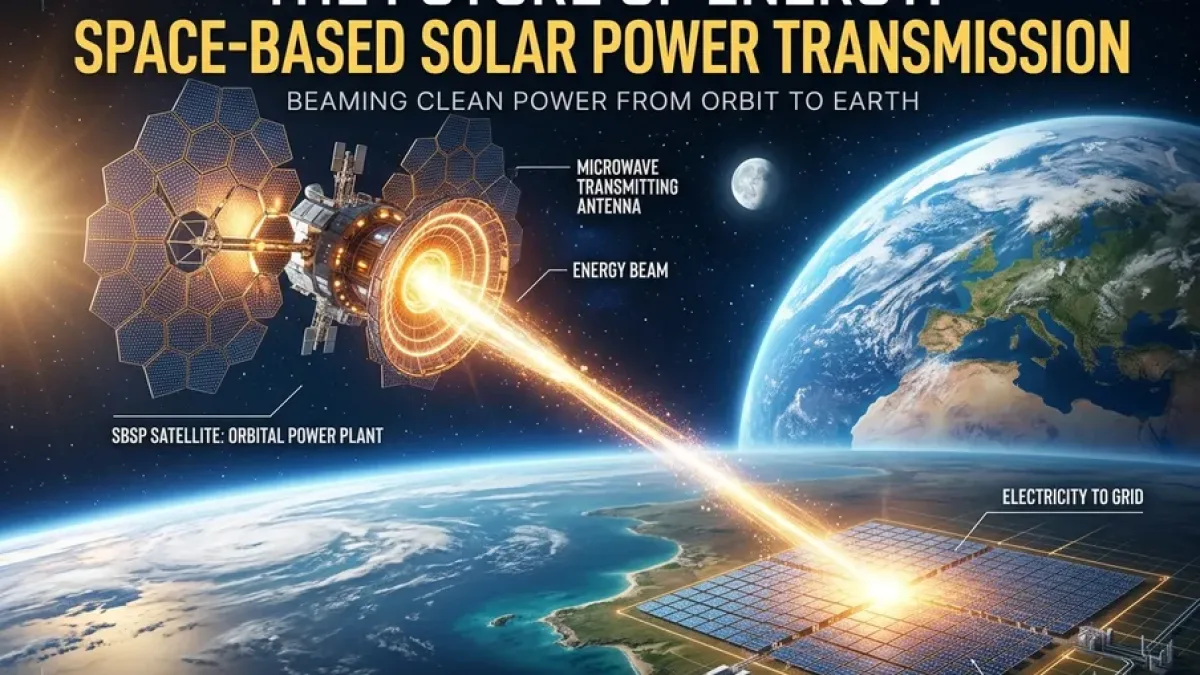
Unlike traditional solar panels installed on rooftops or solar farms, space-based solar power systems would place massive solar arrays in Earth’s orbit. These satellites would collect sunlight almost 24 hours a day since they are positioned above the atmosphere and are not blocked by clouds or darkness. The collected energy would then be converted into microwave or laser beams and safely transmitted to receiving stations on Earth, where it would be converted into electricity for homes, businesses, industries, and national power grids.
One of the greatest advantages of Space-Based Solar Power is its ability to generate uninterrupted renewable energy. Conventional solar panels only produce electricity during daylight hours and their performance depends on weather conditions. Orbital solar stations, however, receive significantly stronger and more consistent sunlight, allowing them to generate electricity continuously. This could solve one of the biggest challenges facing renewable energy—intermittent power generation.
Energy security is another major reason governments are investing in SBSP research. Countries that rely heavily on imported fossil fuels could reduce energy dependence by accessing continuous clean electricity generated in space. Unlike oil and natural gas markets, solar energy from orbit would not be affected by geopolitical conflicts or fuel supply disruptions, making national energy systems more resilient.
Space-based solar power could also play a significant role in reducing greenhouse gas emissions. Since the technology relies entirely on solar radiation, it produces electricity without burning fossil fuels or emitting carbon dioxide during operation. As nations work toward net-zero climate goals, SBSP offers a long-term solution for delivering large-scale carbon-free electricity.
Advances in reusable rocket technology are making space-based energy projects more realistic than ever before. Lower launch costs allow companies and space agencies to transport larger solar panels, robotic assembly equipment, and communication systems into orbit more economically than in previous decades. Continued improvements in launch technology are expected to further reduce deployment costs in the coming years.
Artificial intelligence is expected to become a key component of orbital solar power systems. AI-powered software can monitor satellite health, optimize energy collection, adjust transmission angles, detect equipment failures, and coordinate maintenance operations. Intelligent automation reduces operational costs while maximizing power generation efficiency.
Robotic technologies are also critical for constructing large solar arrays in space. Instead of relying entirely on astronauts, autonomous robotic systems can assemble, inspect, repair, and upgrade orbital power stations. These robotic platforms improve safety while enabling infrastructure that would be difficult for humans to build manually in orbit.
Wireless power transmission remains one of the most important technologies behind SBSP. Engineers are developing highly efficient microwave and laser transmission systems capable of safely delivering electricity over thousands of kilometers. Ground-based receiving stations, known as rectennas, convert transmitted electromagnetic energy into usable electrical power with high efficiency.
Remote communities could benefit significantly from this technology. Regions with limited energy infrastructure, isolated islands, and disaster-affected areas may eventually receive stable electricity from orbital solar systems without requiring extensive transmission networks or fossil fuel deliveries. This could improve access to healthcare, education, communications, and economic development.
Industrial sectors that require continuous electricity, such as manufacturing plants, data centers, mining operations, and hydrogen production facilities, could also benefit from uninterrupted clean energy supplied by orbital solar stations. Stable electricity supports higher productivity while reducing dependence on conventional power plants.
The military and emergency response organizations are studying SBSP as a potential source of resilient energy for remote operations. Portable receiving stations could provide reliable electricity during natural disasters or humanitarian missions where conventional infrastructure has been damaged or destroyed.
Despite its enormous promise, Space-Based Solar Power still faces significant technical and economic challenges. Building large orbital structures requires advanced engineering, durable materials, efficient wireless transmission systems, and reliable long-term maintenance capabilities. Initial investment costs remain extremely high compared to existing renewable energy technologies.
Environmental considerations are also important. Engineers must ensure that microwave or laser energy transmission remains safe for people, wildlife, aircraft, and communication systems. Extensive testing and international safety standards will be required before commercial deployment becomes possible.
International collaboration is expected to accelerate the development of SBSP. Governments, universities, private aerospace companies, and energy organizations are increasingly working together to improve solar panel efficiency, orbital construction methods, wireless energy transmission, and space infrastructure management.
Future integration with smart grids could make orbital solar power even more valuable. AI-powered energy management systems may combine electricity from space-based solar stations with terrestrial solar farms, wind turbines, hydroelectric plants, battery storage, and hydrogen systems to create highly reliable, low-carbon energy networks capable of meeting global electricity demand.
Researchers also envision combining SBSP with lunar and deep-space exploration. Future space missions could use orbital solar stations to power spacecraft, lunar bases, communication satellites, and scientific research facilities, reducing dependence on conventional onboard fuel sources.
Although commercial deployment is still several years away, continued innovation in aerospace engineering, renewable energy, robotics, artificial intelligence, and wireless power transmission is steadily bringing Space-Based Solar Power closer to reality. As launch costs continue falling and technology matures, orbital solar energy may become one of the world's most important clean energy sources.
Space-Based Solar Power in 2026 represents more than an ambitious scientific concept—it offers a vision of a future where humanity can harness nearly unlimited solar energy from space to power homes, industries, transportation, and emerging technologies while dramatically reducing global carbon emissions and strengthening long-term energy security.