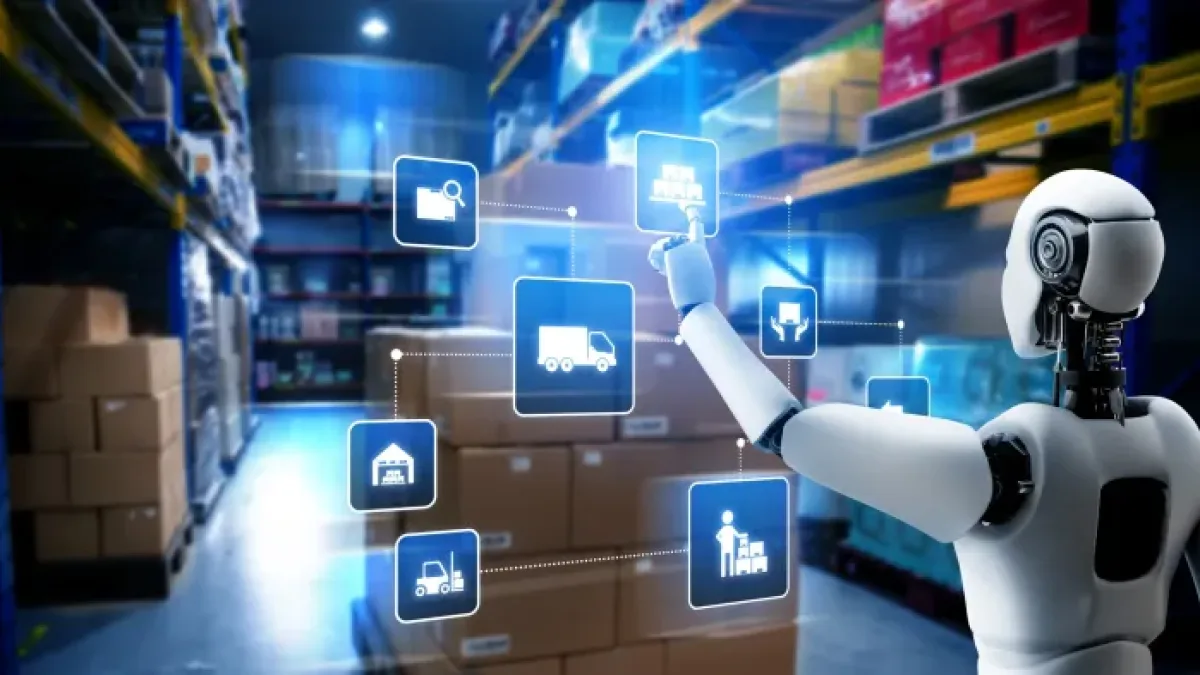
In 2026, Artificial Intelligence (AI) is revolutionizing warehouse operations by creating faster, smarter, and more efficient fulfillment centers. As e-commerce continues to grow and customer expectations for rapid delivery increase, businesses are adopting AI-powered warehouse automation systems to optimize inventory management, improve order accuracy, reduce labor-intensive tasks, and enhance supply chain performance. By integrating Machine Learning (ML), Computer Vision, Internet of Things (IoT) sensors, robotics, cloud computing, edge computing, digital twins, and predictive analytics, AI is enabling highly intelligent smart warehouse automation environments.
One of the most important applications of AI is real-time inventory optimization. AI continuously analyzes stock levels, order history, seasonal demand, supplier lead times, and customer purchasing patterns to maintain optimal inventory levels. Intelligent systems can automatically recommend replenishment orders, reduce excess inventory, and prevent stock shortages.
Autonomous mobile robots (AMRs) have become a major advancement in modern warehouses. AI-powered robots navigate warehouse aisles, transport inventory, assist with picking operations, and optimize travel routes. Using computer vision, LiDAR, and sensor fusion, these robots can avoid obstacles, coordinate with human workers, and operate safely in dynamic warehouse environments.
Order fulfillment optimization is another critical benefit of AI. Machine learning analyzes order priority, product location, packing requirements, shipping deadlines, and workforce availability to determine the most efficient picking and packing sequence. This reduces fulfillment time while improving order accuracy.
Computer Vision is transforming warehouse operations through automated barcode scanning, package identification, damage detection, and inventory verification. AI-powered cameras can identify misplaced products, detect packaging defects, and confirm that the correct items are picked before shipment.
Predictive maintenance helps warehouse operators manage conveyors, robotic systems, forklifts, automated storage systems, and sorting equipment. AI analyzes vibration, temperature, motor performance, and operational data to predict equipment failures before they occur, reducing downtime and maintenance costs.
Digital Twin technology is enabling companies to create virtual replicas of warehouse facilities, storage systems, and fulfillment workflows. AI uses these digital twins to simulate operational scenarios, evaluate layout changes, identify bottlenecks, and optimize throughput before implementing physical modifications.
Edge computing supports time-sensitive warehouse operations by processing sensor and camera data locally. Robotic navigation, quality inspections, and automated sorting decisions can occur instantly without relying entirely on cloud connectivity.
Cloud computing complements edge systems by providing centralized analytics, multi-warehouse monitoring, long-term data storage, and AI model training. Managers can access real-time dashboards showing inventory levels, robot performance, order status, equipment health, and operational efficiency across multiple facilities.
Workforce collaboration has become more effective through AI-assisted tools. Intelligent systems guide workers to optimal picking routes, provide real-time task updates, and help balance workloads across teams, improving productivity while reducing physical strain.
Sustainability is one of the greatest advantages of AI-driven warehouse automation. By optimizing storage utilization, reducing unnecessary movement, improving energy efficiency, and minimizing packaging waste, AI helps organizations lower operational costs and reduce environmental impact.
Cybersecurity has become increasingly important as warehouse infrastructure becomes more connected. AI-powered security platforms monitor operational networks, IoT devices, robotics systems, cloud environments, and access control systems for suspicious activity. Encrypted communications and continuous monitoring help protect critical logistics operations from cyber threats.
Despite its many benefits, AI in warehouse automation still faces challenges including implementation costs, integration with legacy systems, workforce training, data quality management, and cybersecurity risks. However, advances in robotics, AI software, cloud platforms, industrial IoT, and 5G connectivity continue to accelerate adoption across logistics and e-commerce industries.
Looking toward the future, AI-powered warehouses will integrate with autonomous delivery vehicles, drone-based inventory inspections, blockchain-based supply chain tracking, advanced digital twins, and fully connected smart logistics ecosystems. These innovations will create more adaptive, transparent, and efficient fulfillment networks capable of responding dynamically to changing customer demand.
AI in Smart Warehouse Automation 2026 represents a major milestone in the digital transformation of logistics and fulfillment operations. By combining artificial intelligence, predictive analytics, computer vision, robotics, IoT sensors, digital twins, cloud computing, edge computing, and intelligent automation, organizations can improve inventory accuracy, accelerate order fulfillment, reduce operational costs, strengthen supply chain resilience, enhance sustainability, and build smarter warehouses for the future.