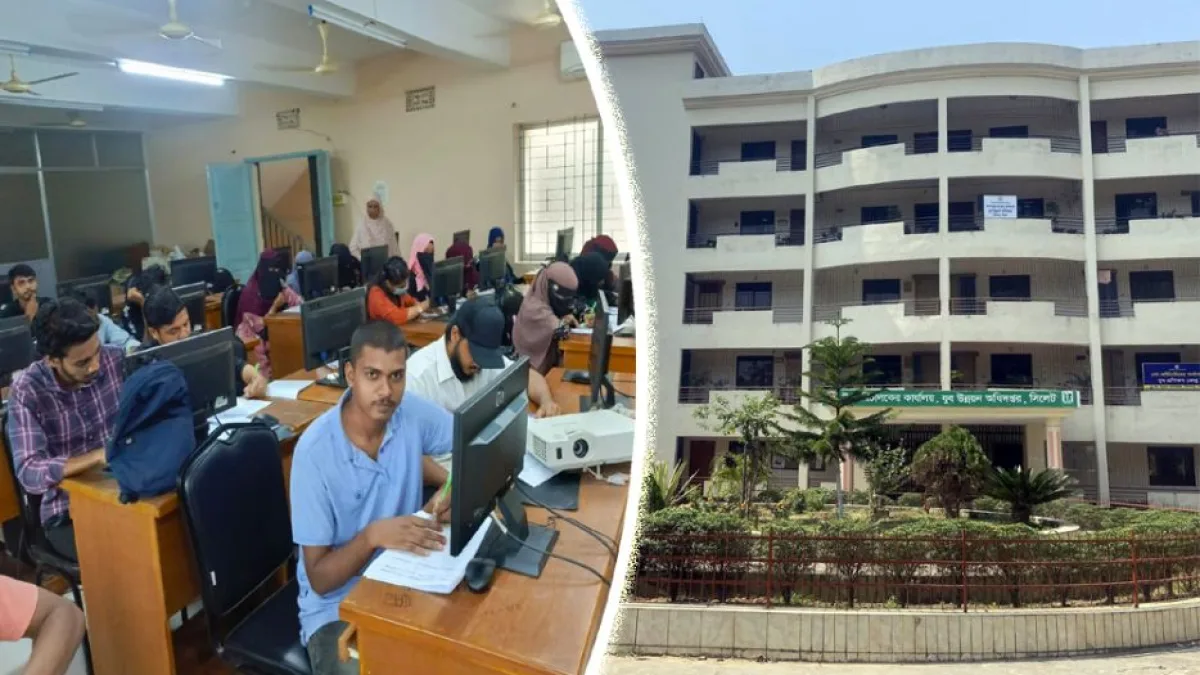
The activities of the Department of Youth Development are gradually adapting to changing times, with greater emphasis being placed on technology-based training. In response to growing interest among young people, training programmes on artificial intelligence (AI) and freelancing have also been introduced.
Interest among Sylhet’s youth in receiving training from the Department of Youth Development and pursuing careers as entrepreneurs is increasing. So far, around 35,000 young men and women have received training in various categories under the department.
However, while demand for training is growing, the number of available training categories is shrinking. Of the 31 training trades previously offered, 23 have either been discontinued or are operating irregularly due to manpower shortages and what officials describe as a lack of government initiative. Of the remaining eight categories, two are being operated under public-private partnerships (PPP), while the other six are struggling with a shortage of trainers.
According to sources concerned, the Department of Youth Development began its activities in 1981 in six districts, including Sylhet. Since its inception, the department has provided training in 31 trades or categories.
Many trainees have gone on to become entrepreneurs after completing three- to six-month residential and non-residential courses. Others have secured government and private-sector jobs using their training certificates. The certificates are also considered evidence of skilled manpower when applying for jobs abroad.
As a result, the importance and demand for such training among Sylhet’s youth have continued to grow. However, training programmes aimed at developing skilled young people are gradually being discontinued because of a shortage of trainers.
According to sources, six training trades are currently being offered under the Sylhet divisional office of the Department of Youth Development. These include three-month residential courses on livestock and poultry farming, primary healthcare, fisheries and agriculture.
There are also six-month courses on Basic Computer and ICT Applications, Electrical and House Wiring, Electronics, and Refrigeration and Air Conditioning. In addition, three-month mobile-van-based training in computer networking is available, while freelancing and AI training are being offered under PPP arrangements.
The PPP-based freelancing and AI courses are being conducted at the Bholananda Night School building, owned by Sylhet City Corporation, in Chouhatta. The other training programmes are conducted at the department’s complex in Tilagarh Alurtal.
Each of the six regular trades is supposed to have two trainers, but currently there is only one trainer for each trade. As a result, training activities are disrupted whenever a trainer is on leave, falls ill or is otherwise absent.
Meanwhile, training programmes in garment making, fisheries, modern office management and computer applications, tourist guiding, salesmanship, English language, housekeeping, beautification, mobile servicing and repair, self-employment to entrepreneurship development, handicrafts and jute products, welding, networking, database management, youth kitchen, electrical and house wiring and solar systems, graphic design, front desk management, mushroom cultivation, catering, agriculture and horticulture, and web design have been discontinued due to a shortage of trainers.
Garment-making was one of the most popular discontinued trades. A total of 4,045 people received training in the programme before it was eventually shut down.
Officials of the department said some of the discontinued trades are considered “specialised training trades”. Training in these areas is arranged in one or two batches a year rather than being offered throughout the year.
Members of civil society in Sylhet believe that training programmes that help create entrepreneurs and skilled workers should be resumed to boost employment opportunities in the country.
Abdul Jabbar Jalil, former senior vice-president of the Sylhet Metropolitan Chamber of Commerce and Industry, said reducing unemployment and turning the population into a skilled workforce are essential for the country’s progress.
“The Department of Youth Development plays an important role in making Sylhet’s young people self-reliant. If training programmes in areas such as office management, housekeeping, mobile servicing and repair, networking, database management, electrical and house wiring, graphic design, front desk management and web design are resumed, trained young people will have greater opportunities to become entrepreneurs at home and will also be recognised as skilled workers if they seek employment abroad,” he said.
Mohammad Abdur Rauf Shah, deputy director of the Department of Youth Development in Sylhet, said interest among young people in training had increased compared with previous years.
“However, there is a shortage of trainers in the training programmes. Each trade is supposed to have two trainers, but currently there is only one,” he said.
He also said that each upazila is supposed to have one youth development officer and three assistant officers, but many of those positions remain vacant.
The deputy director said many young men and women had become self-reliant after receiving training and created their own employment opportunities. Some had also created jobs for others, while many had secured government and private-sector employment using their training certificates.