As businesses generate massive amounts of data every second, relying solely on centralized cloud computing is no longer enough. In 2026, AI-Powered Edge Computing has become one of the most important technologies driving digital transformation across industries. By processing data closer to where it is created—whether on smart devices, sensors, cameras, industrial equipment, or autonomous vehicles—edge computing delivers faster response times, lower latency, improved security, and greater operational efficiency.
Traditional cloud computing requires devices to send information to remote data centers before receiving instructions. While this model works well for many applications, it introduces delays that can become critical in environments where real-time decision-making is essential. AI-powered edge computing solves this challenge by bringing artificial intelligence directly to edge devices, allowing data to be analyzed and acted upon instantly without depending entirely on internet connectivity.
One of the biggest applications of edge AI is the Internet of Things (IoT). Millions of connected sensors installed in factories, hospitals, farms, retail stores, and smart cities continuously generate enormous volumes of information. Instead of transmitting every piece of data to the cloud, edge AI processes important events locally, reducing bandwidth usage and enabling immediate responses. This makes IoT systems faster, more reliable, and significantly more efficient.
Manufacturing companies are rapidly adopting edge computing to power Industry 5.0 initiatives. AI-enabled cameras inspect products for defects in real time, while intelligent sensors monitor machinery for signs of wear or failure. Predictive maintenance systems analyze equipment performance instantly, allowing maintenance teams to resolve issues before expensive breakdowns occur. This reduces downtime, improves product quality, and increases production efficiency.
Healthcare is another sector benefiting from edge AI. Hospitals use intelligent medical devices that analyze patient data locally, allowing doctors to receive immediate alerts when abnormal heart rhythms, oxygen levels, or other critical health indicators are detected. Wearable devices powered by edge AI continuously monitor patients with chronic diseases, providing faster emergency responses while protecting sensitive medical data through local processing.
Autonomous vehicles rely heavily on edge computing because driving decisions must be made within milliseconds. Self-driving cars process information from cameras, radar, LiDAR, GPS, and onboard sensors in real time to detect obstacles, recognize traffic signs, avoid collisions, and navigate safely. Processing this information locally eliminates the delays that could occur if every decision depended on cloud servers.
Smart cities are becoming increasingly intelligent through edge AI deployment. Connected traffic lights optimize vehicle flow based on live traffic conditions, surveillance cameras identify public safety incidents instantly, and environmental monitoring stations detect air pollution, noise levels, and weather changes in real time. These systems help city authorities improve transportation, emergency response, and urban sustainability while minimizing network congestion.
Retail businesses use edge computing to enhance customer experiences and improve operational efficiency. AI-powered cameras monitor inventory levels, detect empty shelves, analyze customer movement, and optimize store layouts without constantly transmitting video to cloud servers. Self-checkout systems, personalized digital displays, and smart vending machines also benefit from local AI processing, delivering faster and more reliable customer service.
In agriculture, edge AI supports precision farming by analyzing data from soil sensors, weather stations, drones, and autonomous farming equipment directly in the field. Farmers receive immediate recommendations for irrigation, fertilization, and pest control even in remote locations with limited internet access. This improves crop yields while reducing water consumption and production costs.
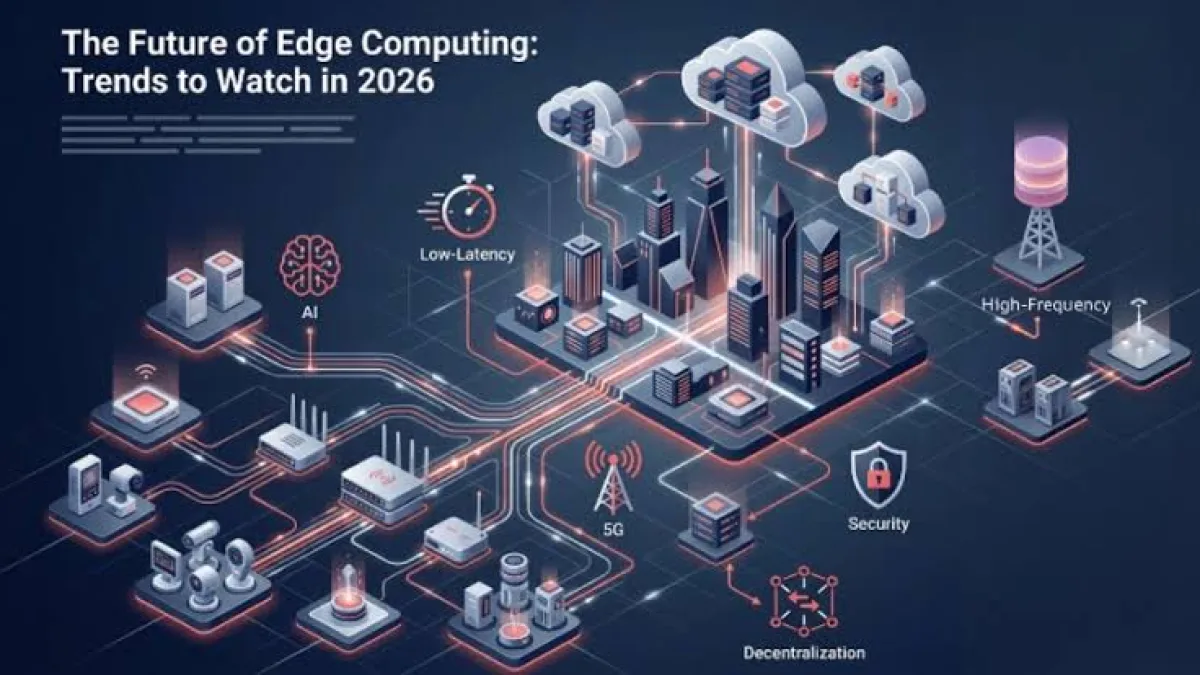
Cybersecurity is strengthened through edge computing because sensitive information can remain on local devices instead of being transmitted across public networks. Organizations implement AI-powered threat detection at the edge to identify suspicious activities, unauthorized access attempts, and malware infections before they spread across enterprise systems. Combined with encryption, zero-trust security, and secure device authentication, edge AI significantly enhances data protection.
Cloud computing continues to play an important role alongside edge computing. Hybrid architectures combine the strengths of both technologies by allowing edge devices to process urgent tasks locally while sending summarized data to cloud platforms for long-term storage, advanced analytics, and AI model training. This balanced approach delivers high performance while maintaining scalability and centralized management.
Telecommunications companies are accelerating edge AI adoption through 5G networks. High-speed, low-latency connectivity allows intelligent devices to communicate efficiently while supporting applications such as augmented reality, virtual reality, remote robotics, industrial automation, and autonomous transportation. Together, 5G and edge AI are creating the foundation for next-generation digital services.
Despite its rapid growth, AI-powered edge computing faces several challenges. Organizations must address hardware limitations, device management, software updates, cybersecurity risks, interoperability, and deployment costs. However, advances in AI chips, energy-efficient processors, edge software platforms, and distributed computing architectures are making edge AI increasingly accessible across industries.
Looking toward the future, AI-powered edge computing will become a fundamental technology supporting smart factories, intelligent healthcare, autonomous vehicles, connected infrastructure, industrial automation, digital twins, robotics, and next-generation IoT ecosystems. As artificial intelligence becomes more efficient and hardware continues to evolve, billions of intelligent edge devices will process information independently while collaborating seamlessly with cloud platforms.
AI-Powered Edge Computing in 2026 represents a major shift in how organizations process and use data. By combining artificial intelligence, edge computing, IoT, 5G, cloud infrastructure, and real-time analytics, businesses can improve operational efficiency, strengthen cybersecurity, reduce latency, and deliver faster, smarter, and more reliable digital services across every major industry.