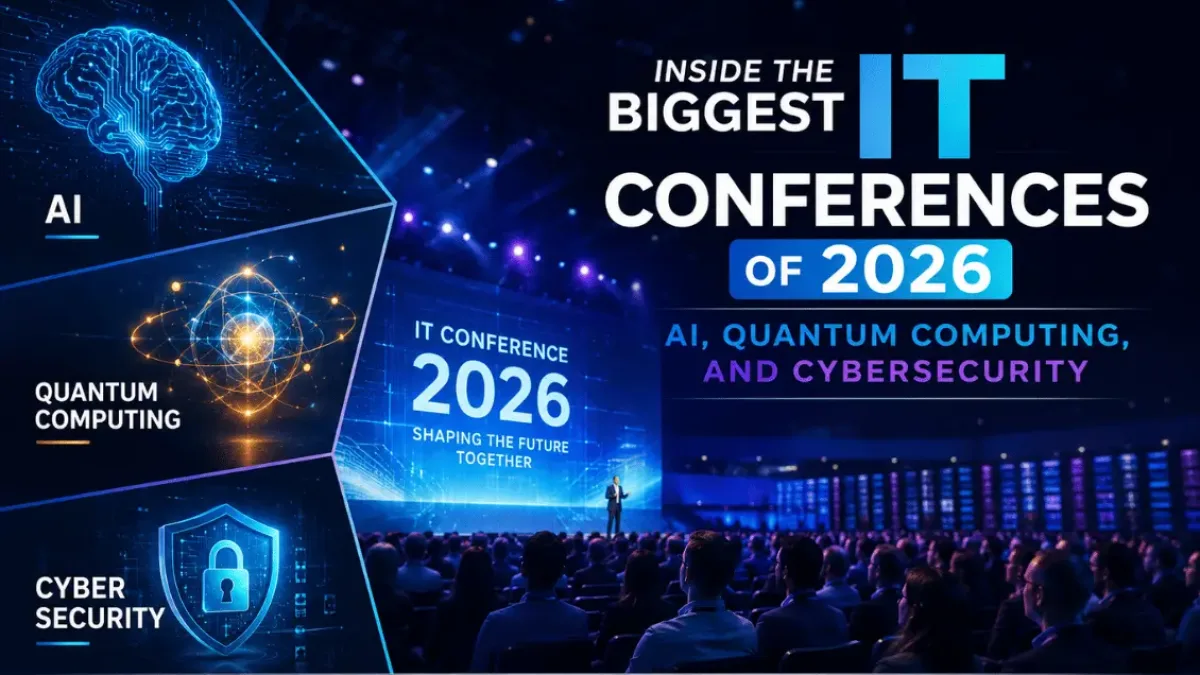
The convergence of Artificial Intelligence (AI) and Quantum Computing is creating one of the most exciting technological breakthroughs of 2026. While classical computers process information using binary bits (0s and 1s), quantum computers use quantum bits, or qubits, which can exist in multiple states simultaneously through the principles of superposition and entanglement. When combined with AI, quantum computing has the potential to solve problems that would take today's most powerful supercomputers years—or even centuries—to complete.
AI in Quantum Computing is transforming industries by accelerating data analysis, optimizing complex systems, improving machine learning models, and enabling scientific discoveries at an unprecedented scale. Governments, research institutions, and technology companies are investing billions of dollars into quantum research because of its enormous potential to reshape computing, cybersecurity, healthcare, finance, and manufacturing.
One of the most promising applications is quantum machine learning (QML). Traditional AI models often require enormous computational resources and extensive training time. Quantum computing can process vast datasets more efficiently, allowing AI algorithms to identify patterns, optimize parameters, and learn from data much faster. This could significantly improve image recognition, natural language processing, predictive analytics, recommendation systems, and autonomous decision-making.
Drug discovery and pharmaceutical research are expected to benefit enormously from AI-powered quantum computing. Developing new medicines requires analyzing millions of molecular interactions, a process that can take years using conventional computers. Quantum AI can simulate molecular structures with extraordinary precision, helping researchers identify promising drug candidates, predict chemical reactions, and accelerate clinical research. This advancement could lead to faster treatments for cancer, Alzheimer's disease, rare genetic disorders, and infectious diseases.
Financial institutions are exploring quantum AI to optimize investment portfolios, detect fraud, improve risk management, and perform high-frequency trading analysis. Quantum algorithms can analyze complex financial markets, evaluate countless investment scenarios, and generate predictive insights more efficiently than traditional computing methods. Banks and insurance companies are also investigating quantum optimization to improve pricing models and operational efficiency.
Cybersecurity is entering a new era with quantum technology. While quantum computers may eventually break some current encryption methods, they are also enabling the development of quantum-resistant cryptography and advanced cybersecurity solutions. AI helps identify vulnerabilities, monitor cyber threats, and automate security responses, while quantum encryption technologies promise significantly stronger protection for sensitive information and digital communications.
Manufacturing and industrial engineering are using quantum AI to optimize supply chains, production planning, and material design. Complex manufacturing problems involving thousands of variables can be solved more efficiently using quantum optimization algorithms. Engineers can simulate new materials, improve production workflows, reduce waste, and enhance product quality while lowering operational costs.
Climate science and environmental research are also benefiting from quantum computing. AI-powered quantum simulations help scientists model weather systems, predict climate change impacts, optimize renewable energy production, and design advanced battery technologies. These capabilities support global sustainability initiatives by improving energy efficiency and accelerating clean technology innovation.
Logistics companies use quantum optimization to improve delivery routes, warehouse operations, fleet management, and inventory planning. AI analyzes transportation data while quantum algorithms evaluate millions of possible routing combinations, helping businesses reduce fuel consumption, delivery times, and operational expenses.
Artificial Intelligence is also improving quantum hardware development. AI algorithms optimize qubit stability, identify hardware errors, enhance quantum circuit design, and automate calibration processes. Since quantum computers remain highly sensitive to environmental interference, AI plays a critical role in improving reliability and overall system performance.
Cloud-based quantum computing platforms are making this technology more accessible to businesses and researchers. Organizations no longer need to build expensive quantum hardware to experiment with quantum algorithms. Instead, cloud services provide secure access to quantum processors, allowing developers to test applications, train AI models, and conduct advanced research remotely.
The combination of AI, quantum computing, and high-performance computing (HPC) is accelerating innovation across multiple scientific disciplines. Researchers use hybrid computing systems where classical computers, AI models, and quantum processors work together to solve highly complex problems more efficiently than any single technology could achieve independently.
Despite its enormous promise, quantum computing remains an emerging technology. Challenges such as qubit stability, error correction, hardware scalability, high implementation costs, specialized programming skills, and limited commercial availability continue to slow widespread adoption. However, rapid advances in quantum hardware and AI optimization are bringing practical applications closer every year.
Businesses preparing for the quantum era are investing in workforce development, quantum software research, cybersecurity modernization, and hybrid computing infrastructures. Organizations that begin exploring quantum technologies today will be better positioned to leverage future breakthroughs as the technology matures.
Looking ahead, AI-powered quantum computing is expected to become one of the defining technologies of the next decade. Future applications may include advanced robotics, autonomous transportation, personalized medicine, next-generation materials, intelligent manufacturing, space exploration, and real-time global optimization systems capable of solving challenges previously considered impossible.
AI in Quantum Computing 2026 represents a revolutionary leap beyond traditional computing. By combining artificial intelligence, quantum mechanics, machine learning, and advanced computational science, this emerging technology is opening new possibilities for innovation, accelerating scientific discovery, improving cybersecurity, optimizing business operations, and shaping the future of digital transformation across every major industry.