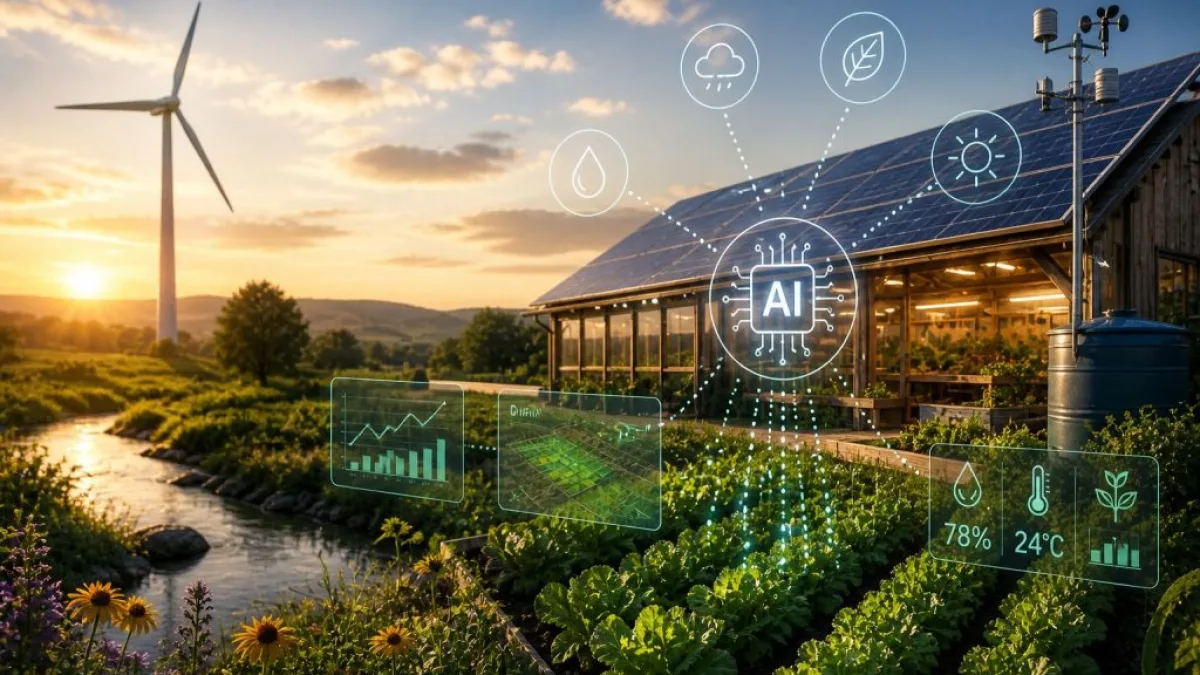
Climate change has become one of the world's most pressing challenges, and in 2026, Artificial Intelligence (AI) in Climate Technology is emerging as a powerful solution for reducing carbon emissions, improving renewable energy efficiency, protecting natural ecosystems, and helping governments and businesses adapt to environmental change. By combining AI with satellite imaging, the Internet of Things (IoT), cloud computing, big data analytics, edge computing, and predictive modeling, climate technology is enabling smarter decisions that support sustainability while accelerating the global transition toward a low-carbon economy.
One of AI's greatest contributions is its ability to analyze massive environmental datasets. Traditional climate models require enormous computing resources and often take significant time to generate forecasts. AI accelerates this process by processing satellite imagery, weather records, ocean temperatures, air quality measurements, and historical climate data to produce faster and more accurate predictions. Governments, scientists, and environmental organizations use these insights to prepare for hurricanes, floods, droughts, wildfires, and other climate-related disasters.
Renewable energy management has become significantly more efficient with AI-powered forecasting. Solar and wind energy production depends heavily on weather conditions, making accurate predictions essential for maintaining stable power grids. AI analyzes weather patterns, cloud movement, wind speed, and historical generation data to forecast renewable energy output with remarkable precision. Utility companies use these predictions to balance electricity supply and demand while reducing reliance on fossil fuels.
Smart electrical grids are another major application of AI in climate technology. Intelligent grid management systems monitor electricity consumption in real time, detect faults, optimize energy distribution, and automatically integrate renewable energy sources. AI helps reduce transmission losses, improve grid reliability, and minimize energy waste while supporting the growing adoption of electric vehicles and distributed energy systems.
Carbon emissions monitoring has also advanced through artificial intelligence. Satellite imagery, industrial sensors, and IoT devices continuously collect environmental data from factories, transportation networks, and urban areas. AI analyzes these datasets to identify emission hotspots, measure greenhouse gas levels, and recommend strategies for reducing environmental impact. Businesses can use these insights to achieve sustainability targets and comply with environmental regulations.
AI is transforming sustainable agriculture by helping farmers reduce water usage, optimize fertilizer application, monitor soil health, and predict crop performance under changing climate conditions. Machine learning models analyze weather forecasts, satellite images, and soil data to recommend efficient farming practices that increase food production while lowering environmental impact.
Forests play a vital role in absorbing carbon dioxide, and AI is becoming an essential tool for forest conservation. High-resolution satellite imagery combined with computer vision detects illegal logging, deforestation, land degradation, and wildfire risks in real time. Environmental agencies can respond more quickly to protect biodiversity and preserve critical ecosystems.
Water resource management is another area benefiting from AI innovation. Intelligent monitoring systems analyze reservoir levels, river flows, rainfall patterns, groundwater conditions, and consumption trends to improve water distribution and conservation. Cities can reduce water waste, detect pipeline leaks early, and prepare for drought conditions using AI-driven forecasting models.
Transportation is one of the largest contributors to global carbon emissions, and AI is helping make mobility more sustainable. Intelligent traffic management systems optimize traffic signals, reduce congestion, and improve fuel efficiency. Logistics companies use AI to optimize delivery routes, while electric vehicle charging networks leverage predictive analytics to balance electricity demand and improve charging infrastructure utilization.
Industries are increasingly adopting AI-powered energy optimization systems to reduce operational costs and emissions. Smart factories monitor equipment performance, optimize production schedules, and minimize energy consumption using real-time analytics. Predictive maintenance also reduces unnecessary downtime while extending the lifespan of industrial machinery.
Artificial Intelligence is accelerating carbon capture and storage research. Machine learning models analyze geological formations, chemical processes, and industrial emissions to improve carbon capture technologies. Researchers are using AI to identify more efficient methods for storing carbon dioxide safely underground or converting it into useful industrial materials.
Climate finance is another rapidly growing field where AI plays an important role. Financial institutions analyze environmental, social, and governance (ESG) data using machine learning to evaluate sustainable investments, measure climate risks, and support green financing initiatives. Businesses gain access to more accurate sustainability assessments that guide responsible investment decisions.
Edge computing and IoT devices enhance climate technology by enabling local environmental monitoring. Smart sensors deployed in forests, farms, oceans, and urban environments collect real-time information on temperature, humidity, pollution levels, and biodiversity. Edge AI processes this data locally, allowing immediate responses without depending entirely on cloud connectivity.
Despite its enormous potential, AI in climate technology faces several challenges. High implementation costs, limited environmental data in some regions, interoperability between monitoring systems, energy consumption of large AI models, and regulatory considerations remain important areas of focus. Researchers continue developing energy-efficient AI models that maximize environmental benefits while minimizing computational resources.
Looking ahead, AI will become one of the most valuable tools for achieving global sustainability goals. Future climate technologies will integrate AI with digital twins, autonomous environmental monitoring systems, advanced robotics, renewable energy infrastructure, and smart cities to create resilient ecosystems capable of adapting to climate change more effectively.
AI in Climate Technology 2026 represents a powerful combination of innovation and environmental responsibility. By leveraging artificial intelligence, predictive analytics, renewable energy optimization, satellite monitoring, and intelligent resource management, organizations around the world are building smarter solutions that protect the planet while supporting sustainable economic growth for future generations.