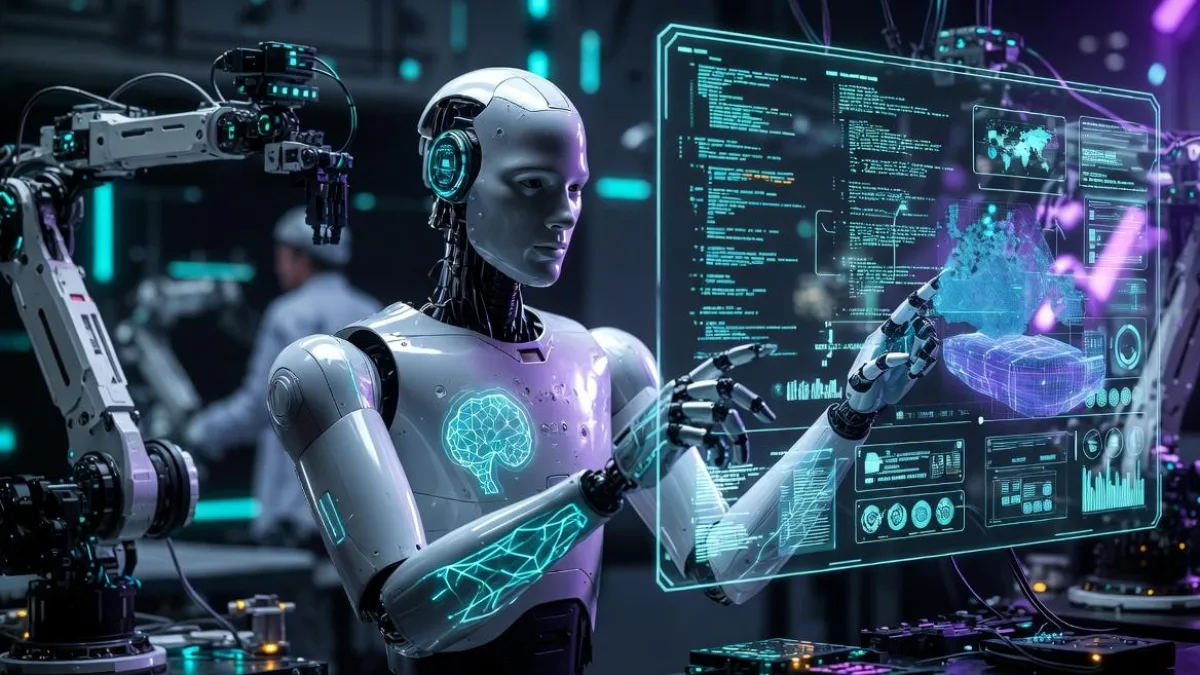
Artificial Intelligence (AI) and robotics are converging faster than ever, making AI Robotics one of the most transformative technologies of 2026. Intelligent robots are no longer limited to factory assembly lines—they are now assisting doctors in hospitals, automating warehouses, harvesting crops, inspecting infrastructure, supporting disaster response, and even helping people in their homes. By combining AI, machine learning, computer vision, sensors, edge computing, and advanced robotics, these systems are becoming more autonomous, adaptable, and capable of performing complex tasks with minimal human intervention.
Unlike traditional industrial robots that follow pre-programmed instructions, AI-powered robots can learn from experience, recognize objects, analyze their surroundings, and make decisions in real time. Through deep learning and computer vision, robots can identify people, detect obstacles, understand gestures, and safely navigate dynamic environments. This allows them to work alongside humans while improving productivity and workplace safety.
Manufacturing remains one of the largest adopters of AI robotics. Smart factories use collaborative robots, or "cobots," to assemble products, inspect quality, package goods, and transport materials. AI continuously analyzes production data to optimize workflows, predict equipment failures, and reduce waste. Manufacturers benefit from increased efficiency, lower operational costs, and consistent product quality while allowing employees to focus on higher-value tasks.
Healthcare is experiencing a major robotics revolution. AI-powered surgical robots assist surgeons with highly precise procedures, reducing recovery times and improving patient outcomes. Hospitals also use robotic assistants to deliver medications, transport medical supplies, disinfect rooms using ultraviolet technology, and support patient care. Rehabilitation robots help patients regain mobility after injuries or strokes by providing personalized therapy programs based on AI-driven analysis.
The logistics and e-commerce industries are rapidly deploying intelligent robots to improve warehouse operations. Autonomous mobile robots move inventory, pick products, sort packages, and prepare shipments with exceptional speed and accuracy. AI-powered warehouse management systems coordinate thousands of robotic movements simultaneously, reducing delivery times while improving inventory accuracy.
Agriculture is becoming smarter with AI robotics. Autonomous tractors, robotic harvesters, crop-monitoring drones, and precision irrigation systems help farmers increase productivity while reducing labor costs and environmental impact. Computer vision enables robots to identify ripe fruits, detect weeds, monitor crop health, and apply fertilizers or pesticides only where needed, supporting more sustainable farming practices.
Retail businesses are integrating robotics into daily operations. Autonomous shelf-scanning robots monitor inventory levels, identify pricing errors, and detect out-of-stock products. Customer service robots assist shoppers by providing directions, answering questions, and recommending products based on AI-powered personalization. These innovations improve operational efficiency while enhancing the overall shopping experience.
AI robotics is also transforming construction and infrastructure development. Robots perform tasks such as bricklaying, welding, concrete inspection, and site surveying with greater precision and consistency. AI-powered drones and robotic inspection systems monitor bridges, tunnels, pipelines, and power lines, identifying structural issues before they become major safety risks.
Public safety organizations rely on robotics for dangerous missions. Bomb disposal robots, firefighting robots, and search-and-rescue machines operate in hazardous environments where human safety would be at risk. Equipped with thermal cameras, LiDAR, and AI navigation systems, these robots locate survivors after natural disasters, inspect unstable structures, and assist emergency response teams.
Artificial Intelligence is the driving force behind modern robotics. Machine learning algorithms allow robots to improve performance over time by learning from previous experiences. Computer vision helps them recognize objects, facial expressions, road signs, and workplace hazards, while natural language processing enables voice communication between humans and robots. Edge AI processors perform complex computations directly on the robot, reducing latency and enabling real-time decision-making even without constant cloud connectivity.
Cloud robotics is another emerging trend in 2026. Robots connected to cloud platforms can share knowledge, receive software updates, and access powerful AI models without requiring expensive onboard computing. A robot that learns a new task in one location can instantly share that knowledge with thousands of similar robots worldwide, accelerating innovation and improving operational consistency.
Cybersecurity has become increasingly important as robots connect to enterprise networks and cloud platforms. Organizations implement encrypted communication, secure authentication, AI-driven threat detection, and regular software updates to protect robotic systems from unauthorized access or cyberattacks. Strong cybersecurity ensures robots operate safely in critical industries such as healthcare, manufacturing, and transportation.
Despite remarkable progress, AI robotics still faces challenges. High development costs, regulatory compliance, workforce training, ethical considerations, and integration with legacy systems continue to influence adoption. Researchers are working to improve battery life, dexterity, human-robot collaboration, and energy efficiency while ensuring robots remain safe, transparent, and trustworthy.
Looking ahead, AI robotics will become a core component of Industry 5.0, smart cities, autonomous transportation, precision agriculture, healthcare innovation, and home automation. As artificial intelligence continues advancing, robots will become more capable of understanding human intentions, collaborating naturally with people, and performing increasingly sophisticated tasks across nearly every industry.
AI Robotics in 2026 represents a significant leap toward a future where intelligent machines work alongside humans to solve complex problems, improve productivity, enhance safety, and drive innovation. By combining robotics, artificial intelligence, computer vision, cloud computing, and automation, AI-powered robots are reshaping industries and creating smarter, more efficient workplaces and communities around the world.