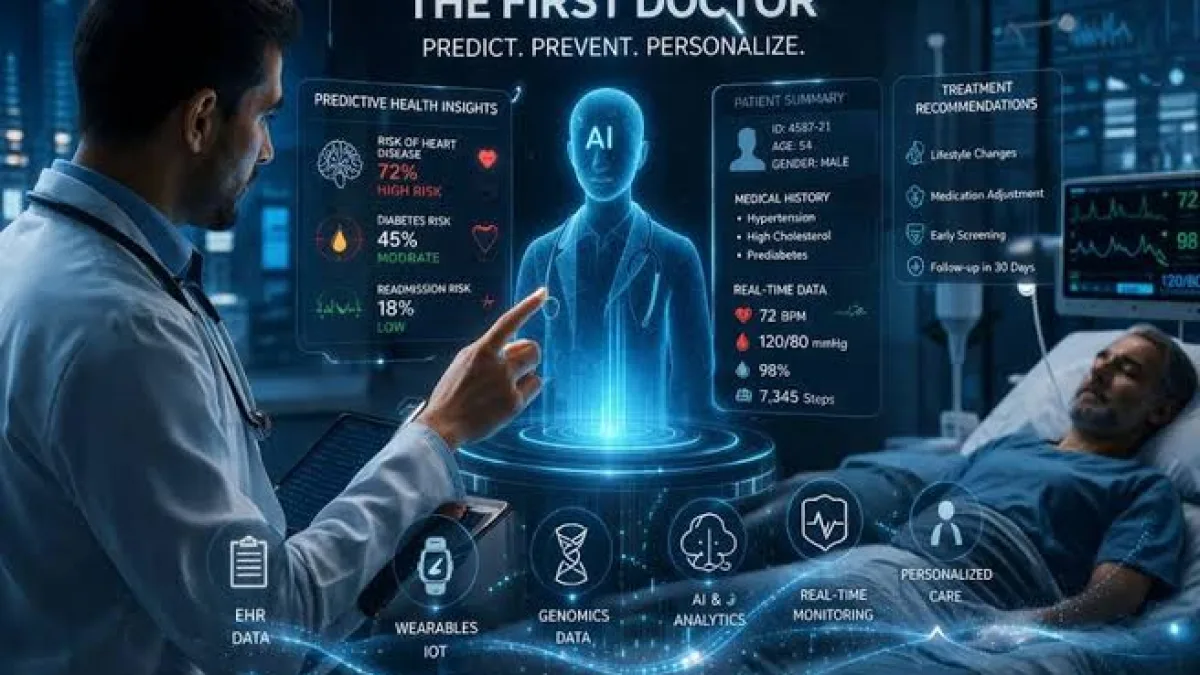
Healthcare is entering a new era where diseases can be predicted before symptoms become severe, treatments can be personalized for every patient, and hospitals can operate more efficiently than ever before. In 2026, AI-Powered Predictive Healthcare is one of the fastest-growing sectors in digital transformation. By combining Artificial Intelligence (AI), Machine Learning (ML), Big Data, Internet of Things (IoT), wearable devices, cloud computing, genomics, and predictive analytics, healthcare providers are improving patient outcomes while reducing costs and increasing operational efficiency.
Predictive healthcare focuses on identifying potential health risks before they develop into serious medical conditions. Instead of simply treating diseases after diagnosis, AI analyzes enormous amounts of patient data—including medical history, laboratory results, medical imaging, genetic information, wearable health data, lifestyle habits, and environmental factors—to predict future health issues with remarkable accuracy.
One of the biggest breakthroughs is early disease detection. AI algorithms can identify subtle warning signs of illnesses such as cancer, heart disease, diabetes, Alzheimer's disease, kidney disorders, and respiratory conditions long before traditional diagnostic methods. Medical imaging systems powered by deep learning can analyze X-rays, MRIs, CT scans, and mammograms, helping radiologists detect abnormalities more quickly and accurately while reducing diagnostic errors.
Personalized medicine is another revolutionary application of AI. Every patient has unique genetic characteristics, lifestyles, and medical histories. AI evaluates these variables to recommend customized treatment plans, optimal medication dosages, and targeted therapies. This approach increases treatment effectiveness while minimizing side effects and improving long-term patient outcomes.
Wearable technology plays a crucial role in predictive healthcare. Smartwatches, fitness trackers, ECG monitors, blood glucose sensors, and wearable biosensors continuously collect health data such as heart rate, blood pressure, oxygen saturation, sleep quality, stress levels, and physical activity. AI analyzes this information in real time and alerts patients or healthcare providers when unusual patterns indicate potential medical problems.
Hospitals are also using predictive analytics to improve patient care and operational efficiency. AI forecasts emergency room admissions, predicts patient discharge times, optimizes staff scheduling, manages hospital resources, and identifies patients who may require intensive care. These insights help healthcare facilities reduce waiting times, improve patient satisfaction, and utilize medical resources more effectively.
Chronic disease management has become significantly more efficient through AI. Patients with diabetes, hypertension, asthma, or cardiovascular diseases receive continuous monitoring through connected devices and mobile health applications. AI tracks disease progression, recommends lifestyle adjustments, and notifies healthcare professionals when intervention is needed, reducing hospital readmissions and improving quality of life.
Artificial Intelligence is also accelerating drug discovery and pharmaceutical research. Machine learning models analyze millions of chemical compounds, biological interactions, and clinical trial results to identify promising drug candidates much faster than traditional research methods. This reduces development costs while helping bring new medicines to market more quickly.
Genomics and AI are working together to advance precision healthcare. By analyzing DNA sequences and genetic mutations, AI helps researchers understand inherited diseases, predict individual health risks, and develop targeted therapies based on each patient's genetic profile. Precision medicine is becoming increasingly important for cancer treatment, rare diseases, and personalized healthcare strategies.
Telemedicine platforms are integrating AI to improve remote healthcare services. Intelligent virtual assistants answer patient questions, schedule appointments, assess symptoms, and provide preliminary health guidance. Physicians can remotely monitor patients using AI-powered dashboards that display real-time health metrics collected from wearable devices and home monitoring systems.
Mental healthcare is also benefiting from predictive AI technologies. Machine learning models analyze speech patterns, behavioral changes, smartphone activity, and questionnaire responses to detect early signs of depression, anxiety, burnout, and other mental health conditions. Early intervention allows healthcare professionals to provide timely support and personalized treatment plans.
AI significantly enhances medical decision support by helping physicians analyze complex patient information. Clinical decision support systems recommend evidence-based treatments, identify potential drug interactions, highlight high-risk cases, and reduce the likelihood of diagnostic mistakes. Rather than replacing doctors, AI serves as an intelligent assistant that supports faster and more informed medical decisions.
Cloud computing provides the infrastructure needed to store and process massive healthcare datasets securely. Edge computing complements cloud platforms by allowing wearable devices and medical equipment to analyze time-sensitive health data locally, reducing response times and protecting patient privacy.
Cybersecurity remains a critical priority in predictive healthcare. Medical organizations implement encryption, multi-factor authentication, AI-driven threat detection, secure cloud environments, and strict access controls to safeguard sensitive patient information and comply with healthcare data protection regulations.
Despite rapid progress, predictive healthcare still faces challenges, including data privacy concerns, regulatory compliance, algorithm transparency, integration with legacy hospital systems, and ensuring AI models remain fair and unbiased across diverse patient populations. Ongoing research and international healthcare standards are helping address these issues while promoting responsible AI adoption.
Looking ahead, predictive healthcare will become a central component of modern medicine. Future healthcare ecosystems will integrate AI, genomics, robotics, digital twins, wearable technology, and real-time patient monitoring to create highly personalized, preventive, and data-driven healthcare systems that improve both individual and public health.
AI-Powered Predictive Healthcare in 2026 represents a major shift from reactive medicine to proactive care. By leveraging artificial intelligence, predictive analytics, wearable devices, genomics, and digital health technologies, healthcare providers can detect diseases earlier, personalize treatments, improve patient outcomes, and build a more efficient, sustainable healthcare system for the future.