In 2026, Artificial Intelligence (AI) is revolutionizing agriculture by enabling farmers to make smarter, faster, and more data-driven decisions. As global food demand rises, climate change intensifies, and natural resources become increasingly limited, AI-powered precision agriculture is helping improve crop yields, reduce production costs, conserve water, and promote sustainable farming practices. By integrating Machine Learning (ML), Computer Vision, Internet of Things (IoT), drones, satellite imagery, robotics, cloud computing, edge computing, and predictive analytics, AI is transforming traditional farming into a highly intelligent and automated ecosystem.
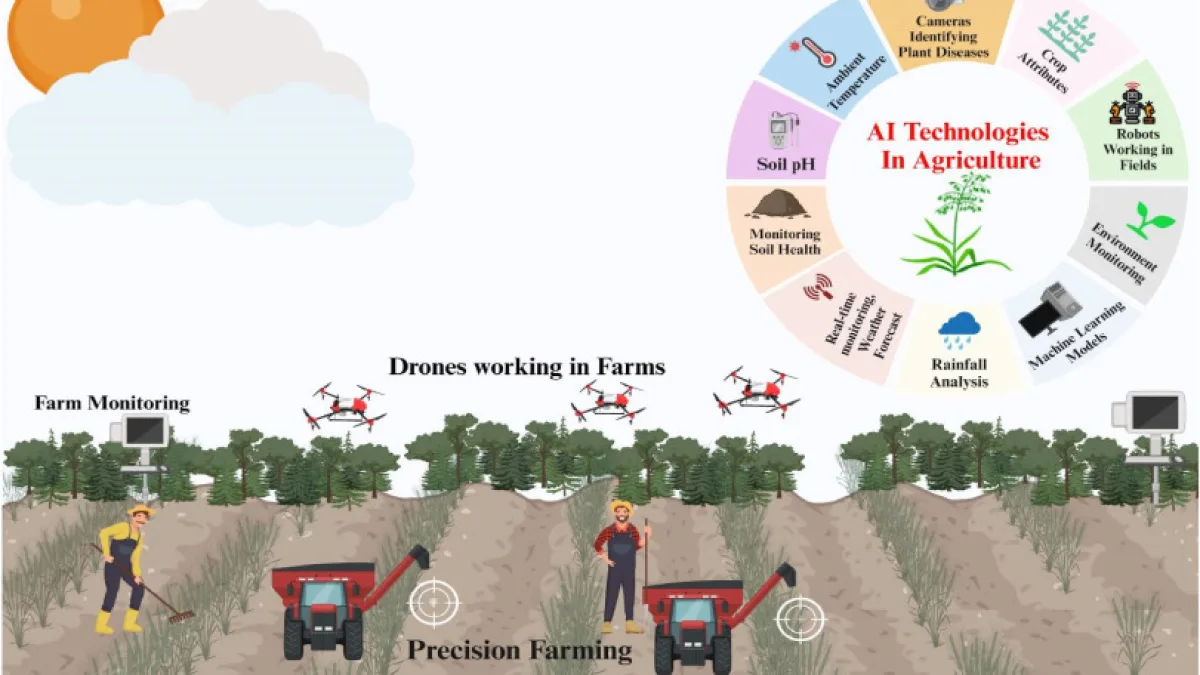
One of the most significant applications of AI in agriculture is precision farming. Instead of treating entire fields uniformly, AI analyzes soil conditions, crop health, weather forecasts, moisture levels, and nutrient availability for specific sections of farmland. Farmers receive detailed recommendations on irrigation, fertilization, and pest control, ensuring that crops receive exactly what they need while minimizing waste and environmental impact.
AI-powered drones and satellite imaging are becoming essential tools for crop monitoring. Equipped with high-resolution cameras, multispectral sensors, and thermal imaging technology, drones capture detailed aerial images of farmland. AI analyzes these images to detect early signs of crop disease, pest infestations, nutrient deficiencies, water stress, and weed growth. Early detection allows farmers to take immediate corrective action before problems spread across entire fields.
Smart irrigation systems are another breakthrough in AI-driven agriculture. IoT sensors continuously monitor soil moisture, temperature, humidity, rainfall, and weather conditions. AI processes this real-time data to determine the optimal amount of water required for each crop. Automated irrigation systems deliver water only when and where it is needed, significantly reducing water consumption while improving crop productivity, especially in drought-prone regions.
Predictive analytics helps farmers make informed planting and harvesting decisions. AI analyzes historical weather patterns, seasonal climate forecasts, soil quality, market demand, and crop performance to recommend the best planting schedules and harvesting times. These insights reduce agricultural risks and maximize profitability.
Computer Vision is transforming automated crop inspection. AI-powered cameras identify diseases, pests, weeds, fruit maturity, and plant health with remarkable accuracy. Autonomous robots equipped with computer vision can selectively remove weeds, apply pesticides only where needed, and harvest ripe fruits without damaging crops. This precision reduces chemical usage, lowers labor costs, and improves overall efficiency.
Livestock farming is also benefiting from AI technologies. Smart sensors and wearable devices continuously monitor animal health, body temperature, movement, feeding behavior, and milk production. AI detects early signs of illness, predicts breeding cycles, and optimizes nutrition plans, helping farmers improve animal welfare while increasing productivity.
Agricultural robots are becoming more common in modern farming operations. Autonomous tractors, robotic harvesters, seed-planting machines, and automated sprayers use AI, GPS, LiDAR, and computer vision to perform farming tasks with minimal human intervention. These intelligent machines improve operational efficiency while addressing labor shortages in the agricultural sector.
Supply chain optimization is another area where AI delivers significant value. AI forecasts crop production, monitors storage conditions, predicts transportation requirements, and optimizes distribution routes. Farmers and food suppliers reduce food waste, improve inventory management, and ensure fresh products reach consumers more efficiently.
Climate resilience has become a critical focus in agriculture. AI models analyze long-term climate trends, rainfall patterns, drought risks, flood forecasts, and temperature changes to help farmers adapt their farming strategies. Predictive recommendations support crop diversification, sustainable land management, and climate-smart agricultural practices.
Cloud computing provides centralized platforms where farmers can access field data, equipment status, weather information, satellite imagery, and AI-generated recommendations from anywhere. Edge computing complements these systems by processing sensor data directly on farms, enabling immediate responses even in areas with limited internet connectivity.
AI also supports sustainable agriculture by reducing fertilizer overuse, minimizing pesticide application, optimizing energy consumption, lowering greenhouse gas emissions, and improving soil conservation. These improvements contribute to environmentally responsible farming while reducing production expenses.
Despite its numerous benefits, AI-powered agriculture still faces challenges such as high implementation costs, limited digital infrastructure in rural areas, farmer training, data integration, equipment maintenance, and cybersecurity concerns. However, ongoing advances in affordable IoT devices, AI software, satellite technology, robotics, and rural connectivity continue to accelerate adoption worldwide.
Looking toward the future, AI in agriculture will integrate with blockchain for food traceability, digital twins for farm simulation, autonomous drone fleets, quantum computing for crop optimization, and next-generation robotics capable of fully automated farming operations. These innovations will help feed a growing global population while preserving natural resources for future generations.
AI in Precision Agriculture 2026 represents one of the most important technological advancements in modern farming. By combining artificial intelligence, IoT, drones, robotics, predictive analytics, cloud computing, and intelligent automation, farmers can increase productivity, improve sustainability, strengthen food security, reduce operational costs, and build a more resilient agricultural future.