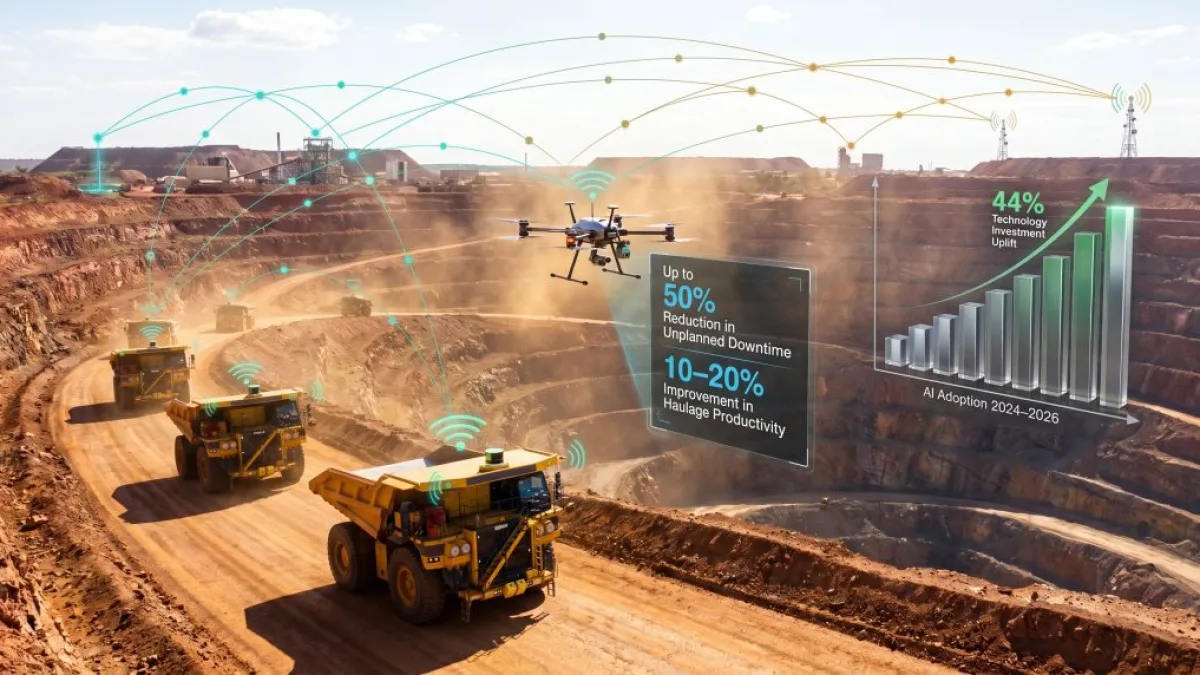
In 2026, Artificial Intelligence (AI) is revolutionizing the mining industry by improving safety, increasing operational efficiency, reducing environmental impact, and enabling smarter resource management. Mining companies are increasingly adopting AI-powered technologies to optimize exploration, automate equipment, predict maintenance needs, and enhance decision-making across the entire mining lifecycle. By integrating Machine Learning (ML), Computer Vision, Internet of Things (IoT), autonomous vehicles, drones, cloud computing, edge computing, digital twins, and predictive analytics, AI is creating highly intelligent and connected smart mining operations.
One of the most significant applications of AI is mineral exploration. Traditional exploration can be time-consuming and expensive, often requiring extensive geological surveys and drilling programs. AI analyzes satellite imagery, geological data, historical exploration records, and geophysical measurements to identify promising mineral deposits with greater accuracy. This helps mining companies reduce exploration costs while increasing the probability of successful discoveries.
Autonomous mining equipment has become a major advancement in modern mining operations. AI-powered haul trucks, drilling rigs, loaders, and excavation machines can operate with minimal human intervention. These intelligent systems use computer vision, LiDAR, radar, and GPS to navigate mining sites, avoid obstacles, optimize routes, and improve productivity while reducing safety risks for workers.
Predictive maintenance is another critical benefit of AI in mining. Heavy equipment generates massive amounts of operational data, including vibration, temperature, pressure, fuel consumption, and engine performance. AI analyzes these patterns in real time to detect early signs of wear or malfunction before equipment fails. Maintenance teams can schedule repairs proactively, reducing costly downtime and extending asset lifespan.
Computer Vision is transforming safety and operational monitoring. AI-powered cameras continuously inspect mining sites, detect unsafe conditions, monitor worker compliance with safety protocols, identify equipment hazards, and analyze material quality. Real-time alerts help prevent accidents and improve overall site safety.
Drone technology combined with AI is widely used for surveying, mapping, stockpile measurement, and environmental monitoring. Drones capture high-resolution aerial images that AI analyzes to create accurate 3D terrain models, monitor excavation progress, and assess site conditions more efficiently than traditional surveying methods.
Digital Twin technology is enabling mining companies to create virtual replicas of mines, processing plants, and equipment fleets. These digital twins receive continuous real-time data from connected sensors, allowing AI to simulate operational scenarios, optimize workflows, predict production outcomes, and evaluate expansion plans before implementing physical changes.
Energy management has become increasingly important as mining companies pursue sustainability goals. AI analyzes electricity usage, fuel consumption, equipment efficiency, and production schedules to optimize energy utilization. Intelligent systems help reduce operational costs and lower greenhouse gas emissions associated with mining activities.
Edge computing supports time-sensitive mining applications by processing sensor and equipment data directly on-site. Autonomous vehicles, drilling systems, and safety monitoring platforms can make immediate decisions without relying entirely on cloud connectivity, improving responsiveness in remote mining locations.
Cloud computing complements edge systems by providing centralized data storage, large-scale analytics, fleet management, production reporting, and AI model training. Mining operators can monitor multiple sites through unified dashboards that provide real-time insights into production, safety, equipment health, and environmental performance.
Environmental sustainability is one of the greatest advantages of AI-driven mining. Intelligent systems optimize resource extraction, reduce waste rock handling, improve water management, minimize energy consumption, and support environmental compliance. AI also helps monitor air quality, tailings storage facilities, and land rehabilitation efforts.
Cybersecurity has become a major priority as mining infrastructure becomes more connected. AI-powered security platforms monitor industrial control systems, autonomous equipment, IoT networks, and cloud environments for suspicious activity. Encrypted communications and continuous monitoring help protect critical mining operations from cyber threats.
Despite its many benefits, AI in mining still faces challenges including high implementation costs, integration with legacy equipment, workforce training, data quality management, remote connectivity limitations, and regulatory compliance. However, advances in autonomous systems, AI software, 5G networks, cloud platforms, and industrial IoT continue to accelerate adoption across the global mining industry.
Looking toward the future, AI-powered mining operations will integrate with autonomous underground vehicles, robotic drilling systems, blockchain-based mineral traceability, quantum optimization, and fully connected digital twin ecosystems. These innovations will create safer, more efficient, and more sustainable mining operations capable of adapting to changing market and environmental conditions in real time.
AI in Smart Mining Operations 2026 represents a major milestone in the digital transformation of the mining industry. By combining artificial intelligence, predictive analytics, computer vision, autonomous equipment, digital twins, cloud computing, edge computing, and intelligent automation, mining companies can improve safety, increase productivity, reduce costs, optimize resource extraction, strengthen environmental performance, and build more sustainable mining operations for the future.