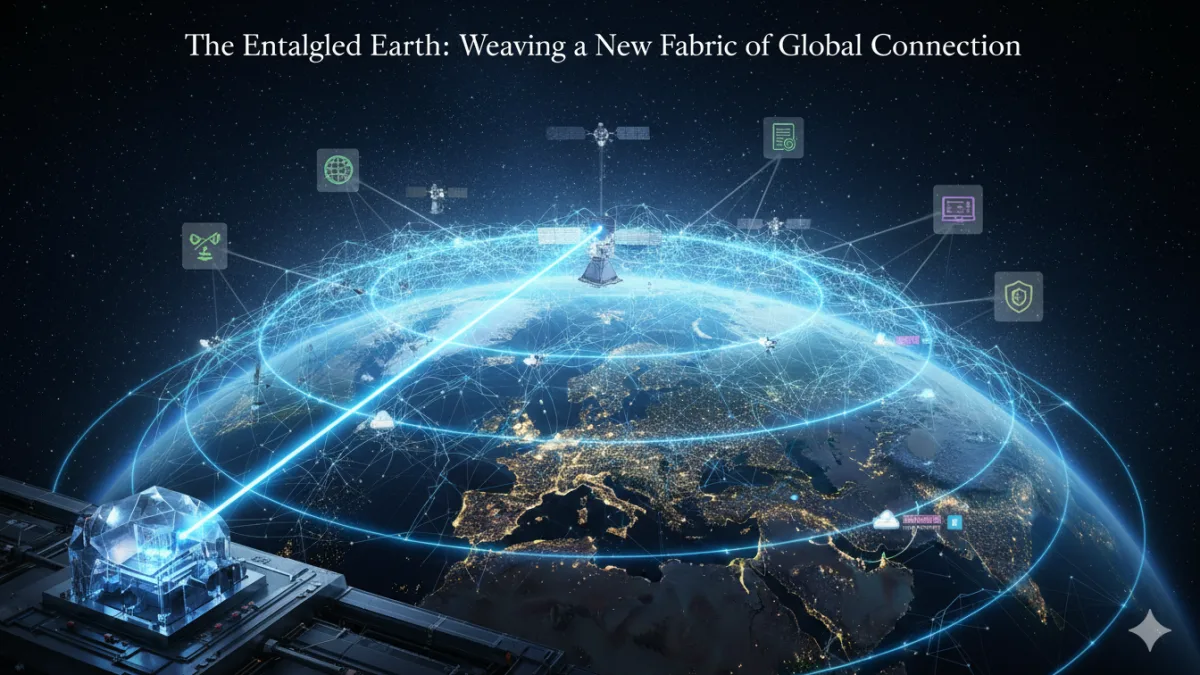
The internet has transformed nearly every aspect of modern life, connecting billions of people and powering global commerce, education, healthcare, entertainment, and government services. However, as cyber threats become increasingly sophisticated and quantum computers continue to advance, traditional encryption methods may eventually become vulnerable to powerful computational attacks. In 2026, one of the most exciting developments in cybersecurity and communications is the emergence of the Quantum Internet—a revolutionary networking technology designed to deliver unprecedented levels of security through the principles of quantum physics.
Unlike today's internet, which transmits classical bits represented as either 0 or 1, the Quantum Internet uses quantum bits (qubits) that can exist in multiple states simultaneously due to quantum superposition. Even more importantly, quantum communication relies on a phenomenon known as quantum entanglement, allowing two particles to remain connected regardless of distance. Any attempt to intercept or observe the transmitted information immediately changes its quantum state, making unauthorized access instantly detectable.
One of the greatest advantages of the Quantum Internet is unbreakable communication security. Traditional encryption depends on mathematical complexity, meaning future quantum computers could eventually crack today's encryption algorithms. Quantum communication, however, relies on the laws of physics rather than computational difficulty. Through Quantum Key Distribution (QKD), two parties can securely exchange encryption keys while instantly detecting any interception attempt. If an attacker tries to eavesdrop, the communication is automatically compromised and the key is discarded before sensitive information is exchanged.
Financial institutions are among the earliest organizations investing in quantum communication. Banks process billions of secure transactions every day and require protection against increasingly advanced cyberattacks. Quantum-secured networks could protect online banking, digital payments, investment systems, and financial communications from both current and future threats, ensuring long-term data confidentiality.
Governments and defense organizations also recognize the strategic importance of quantum networking. National security agencies transmit highly sensitive diplomatic, intelligence, and military information that must remain protected for decades. Quantum communication offers a future-proof solution capable of defending critical government infrastructure against quantum-enabled cyber espionage.
Healthcare is another sector expected to benefit significantly. Hospitals and medical research institutions handle highly confidential patient records, genetic information, diagnostic images, and pharmaceutical research data. Quantum-secure communication can protect medical information while enabling secure collaboration between healthcare providers, research laboratories, and pharmaceutical companies across the globe.
Cloud computing providers are preparing for the quantum era by researching hybrid infrastructures that combine classical computing with quantum communication. Businesses increasingly store valuable intellectual property, financial records, customer information, and operational data in cloud environments. Quantum networking may eventually provide highly secure connections between cloud data centers, reducing the risk of interception during data transmission.
Scientific research is accelerating through quantum networking as well. Universities and research laboratories often collaborate internationally on complex projects involving physics, medicine, climate science, and advanced engineering. Quantum Internet technology can enable researchers to share sensitive experimental data while maintaining exceptional security and integrity throughout collaborative research.
Artificial intelligence may also benefit from quantum communication. Future distributed AI systems could exchange sensitive machine learning models, research datasets, and computational results through quantum-secured networks. This combination of AI and quantum networking could support secure collaborative AI development while protecting valuable intellectual property.
Space exploration agencies are exploring quantum communication for satellite-based networks. Quantum satellites can distribute encryption keys across continents, extending secure communication beyond terrestrial fiber-optic infrastructure. Several successful demonstrations have already shown that quantum communication between satellites and ground stations is technically feasible, laying the foundation for a future global quantum network.
The telecommunications industry is investing heavily in quantum networking infrastructure. Existing fiber-optic networks can support certain quantum communication technologies over limited distances, but extending quantum communication globally requires new innovations such as quantum repeaters. These specialized devices preserve fragile quantum states across long distances, enabling larger quantum communication networks.
One of the biggest technical challenges facing the Quantum Internet is maintaining quantum coherence. Qubits are extremely sensitive to environmental interference such as temperature changes, vibration, and electromagnetic noise. Researchers continue developing advanced error correction methods, improved quantum hardware, and more stable communication channels to overcome these limitations.
Quantum networking will not replace today's internet overnight. Instead, experts expect a gradual evolution where classical networks continue handling conventional data traffic while quantum channels provide ultra-secure communication for critical applications. This hybrid architecture allows organizations to adopt quantum security without completely rebuilding existing infrastructure.
Cybersecurity professionals are also preparing for the transition through Post-Quantum Cryptography (PQC). While the Quantum Internet develops, new cryptographic algorithms resistant to quantum computer attacks are being standardized to protect existing digital infrastructure. Together, post-quantum cryptography and quantum networking will strengthen future cybersecurity across industries.
Businesses that invest early in quantum readiness will likely gain long-term advantages. Financial services, healthcare providers, cloud platforms, telecommunications companies, government agencies, and multinational enterprises are already researching how quantum communication can strengthen operational resilience and protect valuable digital assets.
Despite being in its early stages, the Quantum Internet is advancing rapidly due to significant investments from governments, universities, and technology companies worldwide. Improvements in quantum processors, photonic communication, quantum memory, and network hardware continue bringing practical deployment closer to reality.
Looking toward the future, the Quantum Internet may fundamentally transform global digital infrastructure. Secure communication, distributed quantum computing, advanced scientific collaboration, autonomous systems, and next-generation cloud services could all rely on quantum networks operating alongside classical internet technologies. As quantum innovation accelerates, organizations that prepare today will be better positioned to thrive in tomorrow's secure digital economy.
The Quantum Internet in 2026 represents one of the most important technological frontiers of the coming decade. By combining quantum physics with advanced communication networks, it promises to redefine cybersecurity, protect critical information, and build a safer digital future for businesses, governments, and individuals worldwide.