Artificial Intelligence has become one of the most transformative technologies of the modern era, powering everything from smartphones and autonomous vehicles to healthcare systems and industrial automation. For years, most AI applications depended heavily on cloud computing, where massive data centers processed enormous amounts of information before sending results back to users. While cloud AI remains incredibly powerful, it also introduces challenges such as internet dependency, latency, bandwidth consumption, privacy concerns, and higher operational costs.
In 2026, Edge AI has emerged as one of the fastest-growing technology trends by bringing artificial intelligence directly to the device where data is generated. Instead of continuously sending sensitive information to cloud servers, Edge AI processes data locally on smartphones, laptops, smart cameras, industrial sensors, wearable devices, drones, robots, medical equipment, autonomous vehicles, and countless Internet of Things (IoT) devices.
This shift is fundamentally changing how AI applications operate. Devices become faster, smarter, more secure, and capable of making intelligent decisions in real time—even without an internet connection.
One of the biggest advantages of Edge AI is dramatically reduced latency. Traditional cloud AI requires data to travel from the user's device to a remote server, where it is analyzed before the results are transmitted back. Even with fast internet connections, this round-trip communication introduces delays that may be unacceptable for applications requiring immediate decisions.
Edge AI eliminates much of this delay by performing computations directly on local hardware. Autonomous vehicles, industrial robots, drones, and medical monitoring systems often require responses within milliseconds. Processing data locally enables these systems to react instantly, improving safety, reliability, and user experience.
Privacy has become another major reason organizations are adopting Edge AI. Every day, billions of devices collect personal information including voice recordings, facial images, medical data, financial transactions, location history, and user behavior. Sending all of this information to centralized cloud servers creates potential privacy risks and increases exposure to cyberattacks.
With Edge AI, sensitive information remains on the user's device. Only necessary insights or encrypted summaries may be transmitted when required, significantly reducing the amount of private data that leaves the device. This approach helps organizations comply with increasingly strict privacy regulations while building greater customer trust.
The smartphone industry has become one of the largest adopters of Edge AI. Modern smartphones now include dedicated AI processors capable of running advanced machine learning models directly on the device. Features such as real-time language translation, intelligent photography, voice recognition, spam detection, document scanning, offline assistants, and personalized recommendations operate without requiring continuous cloud connectivity.
Mobile photography has improved dramatically thanks to Edge AI. Smartphone cameras use artificial intelligence to identify scenes, optimize exposure, remove image noise, enhance portraits, improve low-light photography, and even generate professional-quality photos instantly. Since processing occurs locally, users receive immediate results while maintaining privacy.
Healthcare is experiencing a major transformation through Edge AI. Wearable health devices continuously monitor heart rate, blood pressure, blood oxygen levels, sleep quality, stress levels, and physical activity. Instead of uploading raw medical data to cloud servers every second, Edge AI analyzes vital signs directly on the wearable device.
This enables immediate detection of abnormal conditions such as irregular heart rhythms or sudden changes in oxygen levels. Patients and healthcare providers receive instant alerts, allowing earlier medical intervention while protecting sensitive health information.
Hospitals are also integrating Edge AI into medical imaging systems, diagnostic equipment, surgical robots, and patient monitoring platforms. AI assists physicians by identifying abnormalities in X-rays, CT scans, MRI images, and ultrasound examinations with remarkable speed and accuracy.
Manufacturing has become another major beneficiary of Edge AI technology. Smart factories deploy thousands of connected sensors that continuously monitor industrial machines, robotic systems, conveyor belts, production lines, and environmental conditions.
AI algorithms running directly on factory equipment detect equipment failures before breakdowns occur, optimize manufacturing processes, improve product quality, reduce downtime, and lower maintenance costs. Predictive maintenance powered by Edge AI allows manufacturers to repair machinery before costly failures interrupt production.
Quality control has also improved significantly. AI-powered vision systems inspect products in real time, identifying defects that may be invisible to the human eye. Because processing occurs locally, manufacturing decisions can be made instantly without waiting for cloud analysis.
The automotive industry depends heavily on Edge AI. Self-driving vehicles generate enormous amounts of data from cameras, radar, lidar, ultrasonic sensors, GPS systems, and onboard computers. Sending all this information to cloud servers would create unacceptable delays and require massive internet bandwidth.
Instead, Edge AI processes sensor information directly inside the vehicle, allowing autonomous driving systems to detect pedestrians, recognize traffic signs, avoid obstacles, maintain lane positioning, and make split-second driving decisions.
Retail businesses are also embracing Edge AI to improve customer experiences and operational efficiency. Smart stores use AI-powered cameras to monitor inventory, identify empty shelves, analyze customer traffic patterns, and reduce theft. Cashier-less checkout systems rely on local AI processing to recognize products instantly while minimizing cloud infrastructure costs.
Financial institutions use Edge AI to improve fraud detection by analyzing transaction behavior directly at ATMs, payment terminals, and mobile banking applications. Suspicious activity can be identified immediately, reducing financial losses while improving customer security.
Cybersecurity has become one of the strongest use cases for Edge AI. Instead of relying entirely on centralized security systems, intelligent devices can monitor themselves continuously for malware, ransomware, phishing attempts, and suspicious activities. Local threat detection enables organizations to isolate compromised systems before attacks spread across entire networks.
Smart cities are increasingly deploying Edge AI throughout transportation systems, surveillance networks, environmental sensors, public infrastructure, and energy management platforms. AI-powered traffic cameras optimize traffic flow, detect accidents, monitor pedestrian safety, and improve emergency response without overwhelming cloud infrastructure with continuous video uploads.
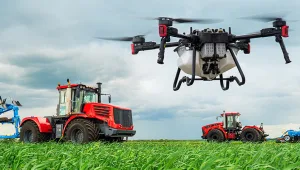
Agriculture is benefiting from Edge AI through intelligent farming equipment, autonomous tractors, crop-monitoring drones, and smart irrigation systems. Farmers receive real-time insights into soil moisture, crop health, pest infestations, and weather conditions, allowing more precise resource management while improving agricultural productivity.
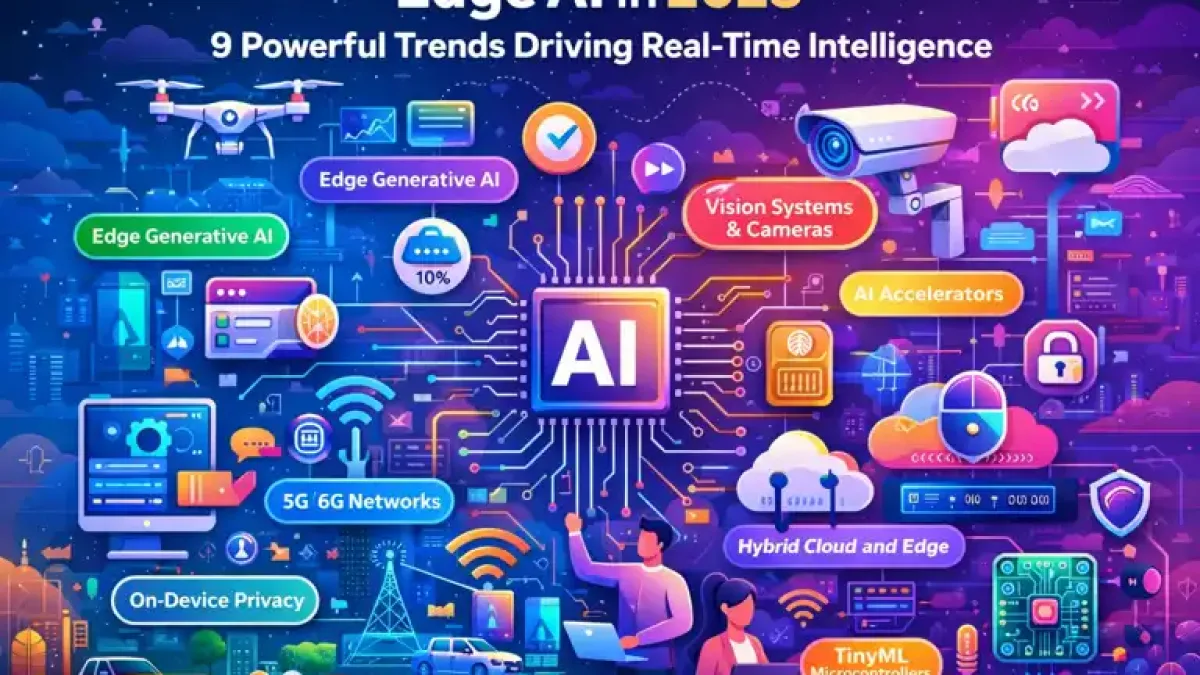
The rapid deployment of 5G networks is accelerating Edge AI adoption worldwide. High-speed connectivity allows edge devices to collaborate efficiently while still processing most information locally. Organizations increasingly use hybrid architectures where Edge AI handles immediate decisions while cloud platforms manage long-term analytics, model training, and centralized coordination.
Specialized AI processors have played a major role in Edge AI's success. Modern chips are designed specifically for neural network processing, delivering exceptional AI performance while consuming very little power. This enables smartphones, drones, smart cameras, and wearable devices to execute complex AI models with impressive battery efficiency.
Despite its enormous advantages, Edge AI still faces challenges. AI models must be optimized to run efficiently on devices with limited memory, storage, and computing power. Managing software updates across millions of connected devices requires sophisticated infrastructure. Cybersecurity remains essential because intelligent edge devices themselves can become targets for attackers.
Nevertheless, rapid advances in semiconductor technology, machine learning optimization, cloud-edge integration, and AI software development continue overcoming these limitations. Businesses across healthcare, finance, manufacturing, transportation, retail, telecommunications, agriculture, and public infrastructure are investing heavily in Edge AI as part of their long-term digital transformation strategies.
Looking toward the future, Edge AI will become the foundation of billions of intelligent connected devices. As artificial intelligence continues moving closer to where data is created, users will experience faster performance, stronger privacy, lower operating costs, improved reliability, and far more responsive digital services.
Edge AI in 2026 represents far more than simply running AI on local devices. It marks a fundamental shift in computing architecture where intelligence moves from distant cloud servers directly into the devices people use every day. This transformation is creating a future where artificial intelligence becomes faster, safer, more efficient, and available everywhere—from smartphones and hospitals to factories, cities, vehicles, and homes.