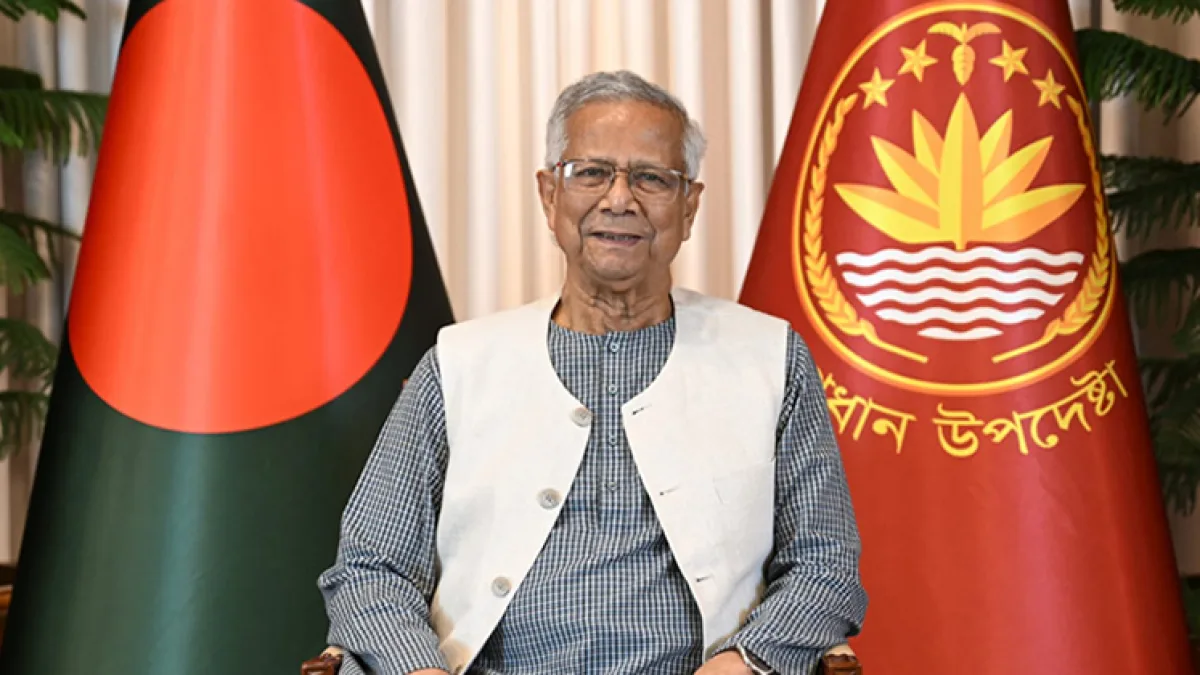
Bangladesh’s recent national election was not merely a transfer of power but the beginning of a new democratic journey for the country, Chief Adviser Professor Muhammad Yunus said on Monday night in a farewell address to the nation.
He described the election as the birth of a “new Bangladesh,” marking a historic turning point in the nation’s democratic evolution.
Delivering his speech on the eve of the interim government’s departure, Yunus congratulated the people for successfully completing a festive, participatory, and peaceful national election — the first such process in 17 years.
He said the election demonstrated a remarkable example of collective responsibility, as voters, political parties, candidates, election authorities, and law enforcement agencies worked together to ensure credibility and transparency.
“This election will serve as an exemplary model for what future elections in Bangladesh should look like,” Yunus said.
Transition After 18 Months of Interim Leadership
Reflecting on the 18-month tenure of the interim government, Yunus stated:
“On the eve of handing over responsibility to an elected government, I stand before you today to bid farewell as the Chief Adviser of the interim administration.”
He recalled the political upheaval of August 5, 2024, when the Sheikh Hasina government fell, and explained the circumstances under which he assumed responsibility.
Describing the immense challenges faced during the transition, Yunus said determining whom to trust within state institutions had become a crisis, especially as reports of violence and disappearances continued to surface.
Despite these difficulties, the government managed to organize a national election alongside a referendum on the July Charter, a consensus-driven constitutional reform initiative.
Yunus described the atmosphere of the election as festive and comparable to Eid celebrations, calling it “a historic moment for the nation.”
Democracy’s Beauty Lies in Competition
Congratulating both winners and losers in the election, Yunus emphasized:
“Victory and defeat are the beauty of democracy.”
He noted that the winning candidates secured nearly half of the total votes, while those who did not win also earned the trust of nearly half of the electorate.
“This balance reflects the maturity of our democratic process,” he added.
Institutional Reforms and Justice
Yunus highlighted sweeping reforms undertaken by the interim government. Approximately 130 new laws and amendments were introduced, alongside nearly 600 executive orders, of which around 84 percent have already been implemented.
These reforms, he said, have strengthened civil rights, reinforced judicial independence, and ensured that enforced disappearances, extrajudicial killings, and authoritarian practices do not return.
He stated that police reforms have fundamentally altered law enforcement practices, ensuring that lethal force is no longer misused and illegal detentions are prevented. The Police Commission Ordinance 2025 was enacted to promote accountability and public trust.
Judicial reforms included establishing a separate secretariat for the judiciary, creating a transparent judicial appointment system, and modernizing civil and criminal laws.
Preventing the Return of Authoritarianism
Yunus stressed that political commitment alone is insufficient to prevent authoritarianism from re-emerging. Instead, deep structural reforms are required.
He said tribunals are actively handling cases related to crimes against humanity, corruption, and enforced disappearances, with several verdicts already delivered.
“The July Charter,” passed overwhelmingly through referendum, was described as the interim government’s greatest achievement.
“Once fully implemented, it will permanently close the door on fascism,” Yunus stated.
Foreign Policy Based on Sovereignty and National Interest
On foreign policy, Yunus said Bangladesh has firmly re-established its sovereignty, national interest, and dignity as guiding principles.
He emphasized that Bangladesh is no longer dependent on external directives and is confident in safeguarding its strategic interests while maintaining balanced international relationships.
Highlighting regional economic potential, Yunus mentioned cooperation opportunities involving Nepal, Bhutan, and India’s northeastern states. Efforts are underway to enhance port efficiency through agreements with international port operators to ensure Bangladesh remains competitive in global trade.
He also confirmed that a recent bilateral trade and tariff agreement with the United States would strengthen Bangladesh’s long-term economic and diplomatic position.
A Responsibility Shared by All
As he concluded his address, Yunus urged citizens to continue safeguarding democracy, accountability, freedom of speech, and civil rights.
“Though we step away from state responsibility, building the new Bangladesh remains the shared duty of all of us.”
He credited the July uprising with opening a historic door for democratic transformation, expressing hope that the nation’s momentum toward progress would remain unstoppable.